SOLDES
Jusqu'à -70% sur une sélection d'articles*

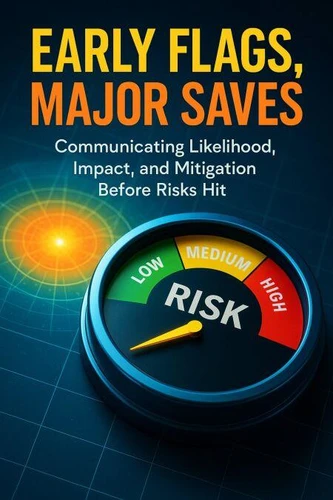
Early Flags, Major Saves. Communicating Likelihood, Impact, and Mitigation Before Risks Hit
Par :Formats :
Disponible dans votre compte client Decitre ou Furet du Nord dès validation de votre commande. Le format ePub est :
- Compatible avec une lecture sur My Vivlio (smartphone, tablette, ordinateur)
- Compatible avec une lecture sur liseuses Vivlio
- Pour les liseuses autres que Vivlio, vous devez utiliser le logiciel Adobe Digital Edition. Non compatible avec la lecture sur les liseuses Kindle, Remarkable et Sony
 , qui est-ce ?
Notre partenaire de plateforme de lecture numérique où vous retrouverez l'ensemble de vos ebooks gratuitement
Pour en savoir plus sur nos ebooks, consultez notre aide en ligne ici
C'est si simple ! Lisez votre ebook avec l'app Vivlio sur votre tablette, mobile ou ordinateur :

- Nombre de pages206
- FormatePub
- ISBN978-3-565-09715-9
- EAN9783565097159
- Date de parution19/11/2025
- Protection num.pas de protection
- Taille552 Ko
- Infos supplémentairesepub
- ÉditeurEmphaloz Publishing House
Résumé
Operational failures rarely arrive without warning-they appear first as subtle signals that get ignored, softened, or buried. This reference-style guide teaches experts and professionals how to communicate risks early, clearly, and credibly, using language that leaders can act on immediately. Instead of vague caution or last-minute escalation, you'll learn a structured way to state likelihood, impact, and mitigation in plain words that remove ambiguity and accelerate response.
Inside, you'll explore a professional communication model built around three anchors: probability phrasing that sets expectations accurately, impact language that avoids drama while highlighting consequence, and mitigation statements that show preparedness instead of panic.
You'll learn how to present risks without alarming stakeholders, how to avoid the softening phrases that hide urgency, and how to craft concise updates that make decision-makers grateful-not frustrated-for the early warning. This guide breaks down why risk communication often fails: unclear definitions, inconsistent terminology, emotional framing, and hesitation rooted in fear of being "negative." You'll learn how to counter each barrier with reference-ready structures that help teams prioritize, allocate resources, and plan confidently.
With practical phrasing, scenario examples, and tight templates, you'll be able to surface problems early enough for your organization to change outcomes, not just react to them. Communicating risks early isn't pessimism-it's responsible leadership. When your words clarify what's coming and how you plan to manage it, you protect projects, people, and performance.
You'll learn how to present risks without alarming stakeholders, how to avoid the softening phrases that hide urgency, and how to craft concise updates that make decision-makers grateful-not frustrated-for the early warning. This guide breaks down why risk communication often fails: unclear definitions, inconsistent terminology, emotional framing, and hesitation rooted in fear of being "negative." You'll learn how to counter each barrier with reference-ready structures that help teams prioritize, allocate resources, and plan confidently.
With practical phrasing, scenario examples, and tight templates, you'll be able to surface problems early enough for your organization to change outcomes, not just react to them. Communicating risks early isn't pessimism-it's responsible leadership. When your words clarify what's coming and how you plan to manage it, you protect projects, people, and performance.
A propos de Talia Westcott















8,49 €
8,99 €