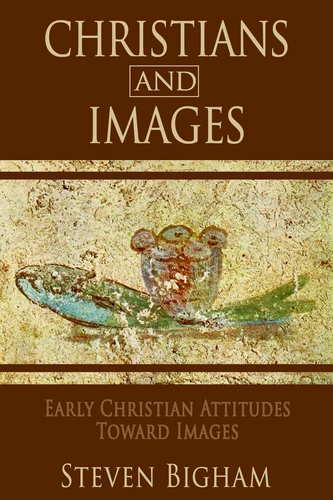
This book aims at combating the Hostility Theory which claims that the Christians in the pagan Roman Empire had no images and rejected them as idolatrous. Did the early Christians, during the first three centuries, 33-313, have images in their churches or places of worship and homes? If they did not, was that because they thought that all images were idols or close to being idols? Did they think that making and having images of Old Testament people and events as well as of Jesus, the apostles and New Testament events was a violation of the 2nd Commandment? Those who accept the Hostility Theory say "No, they had no images" and "Yes, they were against images as a violation of the 2nd Commandment." There are two words to describe this situation: aniconic, that is having no images and iconophobic, that is.
being against them as idols. There are Christian scholars and many believers who accept the Hostility Theory. They say that the introduction of images into the primitive Church was indeed a pollution and corruption of the pure New Testament Gospel. Most of the first Christians were converted Jews, and, according to the Hostility Theory, they carried over with them into their new faith the Jewish hostility to images.
It was the pagan, Greek converts who brought with them their love of images (iconophilia) and introduced images into the Church. Such a paganization, as the Hostility Theory claims, eventually lead to Catholic and Orthodox "idolatry" which the Protestant Reformation wanted to cure by returning to the pure Gospel of the New Testament. The author of this study believes that the Hostility Theory has no grounding and is a false interpretation of the Christianity of those early times and argues, on the basis of the Old Testament, the New Testament, the writings of Christian authors of the period and archeological evidence, that in fact neither the Jews nor the early Christians thought all images were idols and were quite capable of distinguishing theoretically between idolatrous and non-idolatrous art as well of producing such images for the purpose of expressing their faith, and this they did in both word and image.
This book aims at combating the Hostility Theory which claims that the Christians in the pagan Roman Empire had no images and rejected them as idolatrous. Did the early Christians, during the first three centuries, 33-313, have images in their churches or places of worship and homes? If they did not, was that because they thought that all images were idols or close to being idols? Did they think that making and having images of Old Testament people and events as well as of Jesus, the apostles and New Testament events was a violation of the 2nd Commandment? Those who accept the Hostility Theory say "No, they had no images" and "Yes, they were against images as a violation of the 2nd Commandment." There are two words to describe this situation: aniconic, that is having no images and iconophobic, that is.
being against them as idols. There are Christian scholars and many believers who accept the Hostility Theory. They say that the introduction of images into the primitive Church was indeed a pollution and corruption of the pure New Testament Gospel. Most of the first Christians were converted Jews, and, according to the Hostility Theory, they carried over with them into their new faith the Jewish hostility to images.
It was the pagan, Greek converts who brought with them their love of images (iconophilia) and introduced images into the Church. Such a paganization, as the Hostility Theory claims, eventually lead to Catholic and Orthodox "idolatry" which the Protestant Reformation wanted to cure by returning to the pure Gospel of the New Testament. The author of this study believes that the Hostility Theory has no grounding and is a false interpretation of the Christianity of those early times and argues, on the basis of the Old Testament, the New Testament, the writings of Christian authors of the period and archeological evidence, that in fact neither the Jews nor the early Christians thought all images were idols and were quite capable of distinguishing theoretically between idolatrous and non-idolatrous art as well of producing such images for the purpose of expressing their faith, and this they did in both word and image.

 , qui est-ce ?