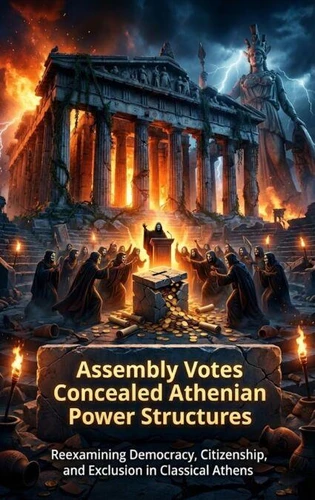
Assembly Votes Concealed Athenian Power Structures. Reexamining Democracy, Citizenship, and Exclusion in Classical Athens
Par :Formats :
Disponible dans votre compte client Decitre ou Furet du Nord dès validation de votre commande. Le format ePub est :
- Compatible avec une lecture sur My Vivlio (smartphone, tablette, ordinateur)
- Compatible avec une lecture sur liseuses Vivlio
- Pour les liseuses autres que Vivlio, vous devez utiliser le logiciel Adobe Digital Edition. Non compatible avec la lecture sur les liseuses Kindle, Remarkable et Sony
 , qui est-ce ?
Notre partenaire de plateforme de lecture numérique où vous retrouverez l'ensemble de vos ebooks gratuitement
Pour en savoir plus sur nos ebooks, consultez notre aide en ligne ici
C'est si simple ! Lisez votre ebook avec l'app Vivlio sur votre tablette, mobile ou ordinateur :

- Nombre de pages145
- FormatePub
- ISBN978-3-565-20557-8
- EAN9783565205578
- Date de parution28/01/2026
- Protection num.pas de protection
- Taille2 Mo
- Infos supplémentairesepub
- ÉditeurEmphaloz Publishing House
Résumé
Athenian democracy is celebrated as the birthplace of political participation. Yet this narrative overlooks a fundamental reality: only adult male citizens could vote, representing roughly 10-15% of the population. Women, enslaved people, and foreign residents-the majority who sustained the city's economy-had no voice in the Assembly that governed their lives.
This book traces how Athenian democracy actually functioned through archaeological evidence, citizen lists, court records, and legislative documents.
It examines who counted as a citizen and why, how wealth influenced political outcomes despite claims of equality, and what democratic participation meant when your neighbor's labor subsidized your freedom to attend Assembly meetings. By analyzing the mechanisms of inclusion and exclusion, this work reveals the gap between democratic ideals and institutional reality. It explores how Athens managed this tension through legal frameworks, social hierarchies, and civic rituals-offering insight into both the achievements and contradictions of the world's first experiment in democratic governance.
It examines who counted as a citizen and why, how wealth influenced political outcomes despite claims of equality, and what democratic participation meant when your neighbor's labor subsidized your freedom to attend Assembly meetings. By analyzing the mechanisms of inclusion and exclusion, this work reveals the gap between democratic ideals and institutional reality. It explores how Athens managed this tension through legal frameworks, social hierarchies, and civic rituals-offering insight into both the achievements and contradictions of the world's first experiment in democratic governance.