SOLDES
Jusqu'à -70% sur une sélection d'articles*

A Simple Guide to Cauda Equina Syndrome, Diagnosis, Treatment and Related Conditions
Par :Formats :
Disponible dans votre compte client Decitre ou Furet du Nord dès validation de votre commande. Le format ePub est :
- Compatible avec une lecture sur My Vivlio (smartphone, tablette, ordinateur)
- Compatible avec une lecture sur liseuses Vivlio
- Pour les liseuses autres que Vivlio, vous devez utiliser le logiciel Adobe Digital Edition. Non compatible avec la lecture sur les liseuses Kindle, Remarkable et Sony
 , qui est-ce ?
Notre partenaire de plateforme de lecture numérique où vous retrouverez l'ensemble de vos ebooks gratuitement
Pour en savoir plus sur nos ebooks, consultez notre aide en ligne ici
C'est si simple ! Lisez votre ebook avec l'app Vivlio sur votre tablette, mobile ou ordinateur :

- FormatePub
- ISBN978-1-005-71196-2
- EAN9781005711962
- Date de parution13/04/2021
- Protection num.pas de protection
- Infos supplémentairesepub
- ÉditeurC. C. Chamberlane
Résumé
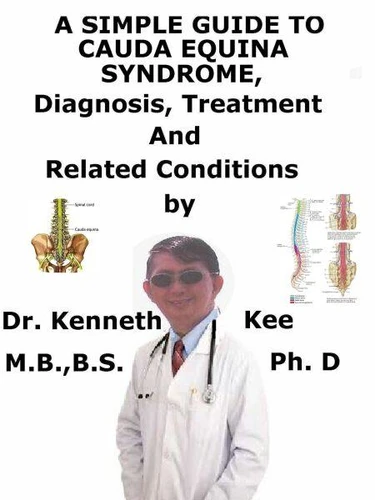
This book describes Cauda Equina Syndrome, Diagnosis and Treatment and Related DiseasesRecently I have a patient who had a daughter who develop cauda equine syndrome while visiting the grandmother in another country. While carrying a heavy pail of water her legs suddenly gave way and she fell to the ground. She was sent to a hospital in that country where a CAT scan showed a fracture in the lumbar disk in L3-4 and a flattened disk in L4-5.
There was pain followed by loss of muscle strength and weakness of the leg especially the left leg. There was also numbness of the both legs and the perineal region (where the anus, vulva and urethra were located) resulting in incontinence of bladder and bowel. She had immediate surgery done to remove the fractured disk in L3-4 and the flattened disk in L4-5. These disks were replaced by metal micro-disks.
During the next 3 weeks she was having physiotherapy done in the hospital with some improvement to the legs. However the numbness of the saddle area (where the anus, vulva and urethra were located) did not improved and she continued to have incontinence of the bladder and bowel. MRI done showed the integrity of the spine with the micro-disks and the nerves were intact and there were no other compression seen.
It was at this time the hospital went into lockdown due to the Covid-19. My patient bought his daughter back to the grandmother's house and had a private physiotherapist to help her with her physical exercises. There was a gradual return of function to the legs with improved movement and sensation. Unfortunately the sensation in the saddle area did not improve. The daughter still has incontinence of the bladder and bowels.
After 1 year and 2 months after the illness, she was able to walk for short distances but she still has problems with her bowel and bladder control. She and her parents were able to return to Singapore by plane. It is for this reason that my patient has consulted me to refer her to a good neurologist for further review of her condition. The bundle of nerves at the end of the spinal cord is termed the cauda equina, due to its resemblance to a horse's tail.
These nerves transmit and receive messages to and from the lower limbs and pelvic organs. The cauda equina continues from the nerve roots in the lumbar region. The cauda equina communicates with the brain, transmitting nerve signals back and forth regarding the sensory and motor functions of the lower limbs and the organs in the pelvic region. If these nerve roots become pinched, the patient can develop a disorder termed cauda equina syndrome (CES).
It is a rare disorder evaluated to affect 1 in 33, 000 to 100, 000 people. Cauda equina syndrome (CES) happens when the nerve roots of the cauda equina are pinched and interrupt motor and sensory function to the lower extremities and bladder. Patients with this syndrome are often sent to the hospital as a medical emergency. CES most often results from a large herniated disc in the lumbar region. Other possible causes of CES are:1.
Lesions or tumors on the lower spine2. Spinal stenosis, 3. Inflammation of the lower spine4. Spinal infection5. Birth defectsMost common symptoms are1. Motor or sensory deficits in the legs - normally bilateral but can also be unilateral and asymmetrical2. Lower motor neuron signs in the legs - areflexia, hypotonia, atrophy3. Saddle anesthesia4. Absent or decreased rectal toneThe gold standard method of evaluation for CES is getting urgent MRI imaging.
Urgent surgery is normally the treatment of choice. If untreated CES can result in permanent paralysis and incontinence. TABLE OF CONTENTIntrod...
There was pain followed by loss of muscle strength and weakness of the leg especially the left leg. There was also numbness of the both legs and the perineal region (where the anus, vulva and urethra were located) resulting in incontinence of bladder and bowel. She had immediate surgery done to remove the fractured disk in L3-4 and the flattened disk in L4-5. These disks were replaced by metal micro-disks.
During the next 3 weeks she was having physiotherapy done in the hospital with some improvement to the legs. However the numbness of the saddle area (where the anus, vulva and urethra were located) did not improved and she continued to have incontinence of the bladder and bowel. MRI done showed the integrity of the spine with the micro-disks and the nerves were intact and there were no other compression seen.
It was at this time the hospital went into lockdown due to the Covid-19. My patient bought his daughter back to the grandmother's house and had a private physiotherapist to help her with her physical exercises. There was a gradual return of function to the legs with improved movement and sensation. Unfortunately the sensation in the saddle area did not improve. The daughter still has incontinence of the bladder and bowels.
After 1 year and 2 months after the illness, she was able to walk for short distances but she still has problems with her bowel and bladder control. She and her parents were able to return to Singapore by plane. It is for this reason that my patient has consulted me to refer her to a good neurologist for further review of her condition. The bundle of nerves at the end of the spinal cord is termed the cauda equina, due to its resemblance to a horse's tail.
These nerves transmit and receive messages to and from the lower limbs and pelvic organs. The cauda equina continues from the nerve roots in the lumbar region. The cauda equina communicates with the brain, transmitting nerve signals back and forth regarding the sensory and motor functions of the lower limbs and the organs in the pelvic region. If these nerve roots become pinched, the patient can develop a disorder termed cauda equina syndrome (CES).
It is a rare disorder evaluated to affect 1 in 33, 000 to 100, 000 people. Cauda equina syndrome (CES) happens when the nerve roots of the cauda equina are pinched and interrupt motor and sensory function to the lower extremities and bladder. Patients with this syndrome are often sent to the hospital as a medical emergency. CES most often results from a large herniated disc in the lumbar region. Other possible causes of CES are:1.
Lesions or tumors on the lower spine2. Spinal stenosis, 3. Inflammation of the lower spine4. Spinal infection5. Birth defectsMost common symptoms are1. Motor or sensory deficits in the legs - normally bilateral but can also be unilateral and asymmetrical2. Lower motor neuron signs in the legs - areflexia, hypotonia, atrophy3. Saddle anesthesia4. Absent or decreased rectal toneThe gold standard method of evaluation for CES is getting urgent MRI imaging.
Urgent surgery is normally the treatment of choice. If untreated CES can result in permanent paralysis and incontinence. TABLE OF CONTENTIntrod...
A propos de Kenneth Kee


4,49 €