- Accueil /
- Perumal Pugazhendhi
Perumal Pugazhendhi

Dernière sortie
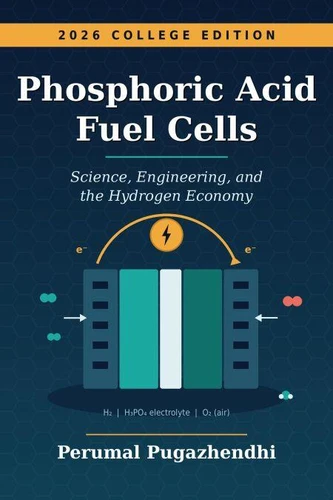
Phosphoric Acid Fuel Cells Science, Engineering, and the Hydrogen Economy
Fuel cells occupy a peculiar place in the modern energy conversation. They are simultaneously the oldest electrochemical power technology-older than the internal combustion engine-and one of the most futuristic. Sir William Grove built the first in 1839; more than a century later, alkaline cells flew to the Moon, and phosphoric acid cells became the first fuel cells to earn a living on the ground, quietly powering hospitals, data centers, and campuses through grid outages that combustion generators could not ride through.
This book is about that workhorse: the phosphoric acid fuel cell, or PAFC. It is not the highest-efficiency cell, nor the smallest, nor the cheapest. What it offers instead is a combination that has proven commercially durable: tolerance to impure, reformed hydrogen; an operating temperature high enough to deliver genuinely useful heat; and a service life measured in decades. In an era of decarbonization and distributed power, those qualities are being rediscovered.
Why a new edition, and why nowThe technology has not stood still, and neither should a textbook about it. The years leading to 2026 brought maturation of high-temperature polybenzimidazole membranes that blur the old line between PAFC and PEMFC, the arrival of machine-learning diagnostics that can hear a stack failing before a human can, and a hydrogen economy that has begun putting real steel in the ground-only to discover, through the project cancellations of 2025 and 2026, how unforgiving the economics of clean fuel remain.
That reckoning, examined in Chapter 23, has if anything strengthened the case for the fuel-flexible stationary technologies this book describes. Meanwhile the costs, capacities, and comparisons that students need have all shifted. This edition updates the numbers, adds the new physics, and-most importantly-rebuilds the material as a course rather than a monograph. Who this book is forThe intended reader is an upper-level undergraduate or beginning graduate student in chemical, mechanical, materials, electrical, or energy engineering, or a working professional entering the field.
The prerequisites are modest: general chemistry, introductory thermodynamics, and enough calculus to be unafraid of a differential equation. Everything else-electrochemistry, transport phenomena, kinetics, reliability, techno-economics-is developed from the ground up, with worked examples at every turn. A word of thanksNo book of this scope is a solitary act. I am grateful to the students whose questions exposed every place the earlier text was unclear, to the engineers who corrected my instincts with field data, and to the reader now holding this edition, who will find the remaining errors.
They are mine. May your cells stay wet, your platinum stay dispersed, and your voltage stay high.
This book is about that workhorse: the phosphoric acid fuel cell, or PAFC. It is not the highest-efficiency cell, nor the smallest, nor the cheapest. What it offers instead is a combination that has proven commercially durable: tolerance to impure, reformed hydrogen; an operating temperature high enough to deliver genuinely useful heat; and a service life measured in decades. In an era of decarbonization and distributed power, those qualities are being rediscovered.
Why a new edition, and why nowThe technology has not stood still, and neither should a textbook about it. The years leading to 2026 brought maturation of high-temperature polybenzimidazole membranes that blur the old line between PAFC and PEMFC, the arrival of machine-learning diagnostics that can hear a stack failing before a human can, and a hydrogen economy that has begun putting real steel in the ground-only to discover, through the project cancellations of 2025 and 2026, how unforgiving the economics of clean fuel remain.
That reckoning, examined in Chapter 23, has if anything strengthened the case for the fuel-flexible stationary technologies this book describes. Meanwhile the costs, capacities, and comparisons that students need have all shifted. This edition updates the numbers, adds the new physics, and-most importantly-rebuilds the material as a course rather than a monograph. Who this book is forThe intended reader is an upper-level undergraduate or beginning graduate student in chemical, mechanical, materials, electrical, or energy engineering, or a working professional entering the field.
The prerequisites are modest: general chemistry, introductory thermodynamics, and enough calculus to be unafraid of a differential equation. Everything else-electrochemistry, transport phenomena, kinetics, reliability, techno-economics-is developed from the ground up, with worked examples at every turn. A word of thanksNo book of this scope is a solitary act. I am grateful to the students whose questions exposed every place the earlier text was unclear, to the engineers who corrected my instincts with field data, and to the reader now holding this edition, who will find the remaining errors.
They are mine. May your cells stay wet, your platinum stay dispersed, and your voltage stay high.

Fuel cells occupy a peculiar place in the modern energy conversation. They are simultaneously the oldest electrochemical power technology-older than the internal combustion engine-and one of the most futuristic. Sir William Grove built the first in 1839; more than a century later, alkaline cells flew to the Moon, and phosphoric acid cells became the first fuel cells to earn a living on the ground, quietly powering hospitals, data centers, and campuses through grid outages that combustion generators could not ride through.
This book is about that workhorse: the phosphoric acid fuel cell, or PAFC. It is not the highest-efficiency cell, nor the smallest, nor the cheapest. What it offers instead is a combination that has proven commercially durable: tolerance to impure, reformed hydrogen; an operating temperature high enough to deliver genuinely useful heat; and a service life measured in decades. In an era of decarbonization and distributed power, those qualities are being rediscovered.
Why a new edition, and why nowThe technology has not stood still, and neither should a textbook about it. The years leading to 2026 brought maturation of high-temperature polybenzimidazole membranes that blur the old line between PAFC and PEMFC, the arrival of machine-learning diagnostics that can hear a stack failing before a human can, and a hydrogen economy that has begun putting real steel in the ground-only to discover, through the project cancellations of 2025 and 2026, how unforgiving the economics of clean fuel remain.
That reckoning, examined in Chapter 23, has if anything strengthened the case for the fuel-flexible stationary technologies this book describes. Meanwhile the costs, capacities, and comparisons that students need have all shifted. This edition updates the numbers, adds the new physics, and-most importantly-rebuilds the material as a course rather than a monograph. Who this book is forThe intended reader is an upper-level undergraduate or beginning graduate student in chemical, mechanical, materials, electrical, or energy engineering, or a working professional entering the field.
The prerequisites are modest: general chemistry, introductory thermodynamics, and enough calculus to be unafraid of a differential equation. Everything else-electrochemistry, transport phenomena, kinetics, reliability, techno-economics-is developed from the ground up, with worked examples at every turn. A word of thanksNo book of this scope is a solitary act. I am grateful to the students whose questions exposed every place the earlier text was unclear, to the engineers who corrected my instincts with field data, and to the reader now holding this edition, who will find the remaining errors.
They are mine. May your cells stay wet, your platinum stay dispersed, and your voltage stay high.
This book is about that workhorse: the phosphoric acid fuel cell, or PAFC. It is not the highest-efficiency cell, nor the smallest, nor the cheapest. What it offers instead is a combination that has proven commercially durable: tolerance to impure, reformed hydrogen; an operating temperature high enough to deliver genuinely useful heat; and a service life measured in decades. In an era of decarbonization and distributed power, those qualities are being rediscovered.
Why a new edition, and why nowThe technology has not stood still, and neither should a textbook about it. The years leading to 2026 brought maturation of high-temperature polybenzimidazole membranes that blur the old line between PAFC and PEMFC, the arrival of machine-learning diagnostics that can hear a stack failing before a human can, and a hydrogen economy that has begun putting real steel in the ground-only to discover, through the project cancellations of 2025 and 2026, how unforgiving the economics of clean fuel remain.
That reckoning, examined in Chapter 23, has if anything strengthened the case for the fuel-flexible stationary technologies this book describes. Meanwhile the costs, capacities, and comparisons that students need have all shifted. This edition updates the numbers, adds the new physics, and-most importantly-rebuilds the material as a course rather than a monograph. Who this book is forThe intended reader is an upper-level undergraduate or beginning graduate student in chemical, mechanical, materials, electrical, or energy engineering, or a working professional entering the field.
The prerequisites are modest: general chemistry, introductory thermodynamics, and enough calculus to be unafraid of a differential equation. Everything else-electrochemistry, transport phenomena, kinetics, reliability, techno-economics-is developed from the ground up, with worked examples at every turn. A word of thanksNo book of this scope is a solitary act. I am grateful to the students whose questions exposed every place the earlier text was unclear, to the engineers who corrected my instincts with field data, and to the reader now holding this edition, who will find the remaining errors.
They are mine. May your cells stay wet, your platinum stay dispersed, and your voltage stay high.
Les livres de Perumal Pugazhendhi
Nouveauté

PLANET PLASTIC Tiny Plastics, Big Questions — and How We Can Protect People, Animals, and Our World
Perumal Pugazhendhi
E-book
11,49 €
Nouveauté

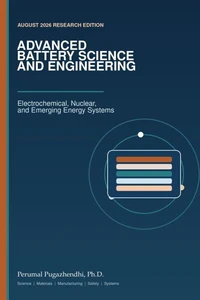
ADVANCED BATTERY SCIENCE AND ENGINEERING Electrochemical, Nuclear, and Emerging Energy Systems
Perumal Pugazhendhi
E-book
13,49 €
Nouveauté

12,99 €
Nouveauté

21,99 €
Nouveauté

13,99 €
Nouveauté

Molten Salts Applications, Challenges, and Future Prospects in Energy Systems
Perumal Pugazhendhi
E-book
13,99 €
Nouveauté

13,49 €
Nouveauté