Gideon Hart is a nonfiction author who writes about leadership, philosophy, and the psychology of decision-making. His work explores how discipline, resilience, and long-term thinking shape both personal growth and success in times of uncertainty.
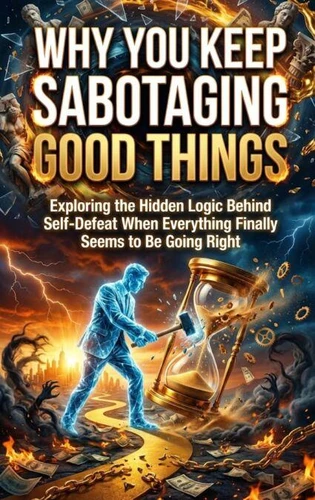
Why You Keep Sabotaging Good Things. Exploring the Hidden Logic Behind Self-Defeat When Everything Finally Seems to Be Going Right
Par :Formats :
Disponible dans votre compte client Decitre ou Furet du Nord dès validation de votre commande. Le format ePub est :
- Compatible avec une lecture sur My Vivlio (smartphone, tablette, ordinateur)
- Compatible avec une lecture sur liseuses Vivlio
- Pour les liseuses autres que Vivlio, vous devez utiliser le logiciel Adobe Digital Edition. Non compatible avec la lecture sur les liseuses Kindle, Remarkable et Sony
 , qui est-ce ?
Notre partenaire de plateforme de lecture numérique où vous retrouverez l'ensemble de vos ebooks gratuitement
Pour en savoir plus sur nos ebooks, consultez notre aide en ligne ici
C'est si simple ! Lisez votre ebook avec l'app Vivlio sur votre tablette, mobile ou ordinateur :

- Nombre de pages158
- FormatePub
- ISBN978-3-565-26574-9
- EAN9783565265749
- Date de parution23/02/2026
- Protection num.pas de protection
- Taille2 Mo
- Infos supplémentairesepub
- ÉditeurEmphaloz Publishing House
Résumé
It follows a familiar, bewildering pattern. Something good arrives - a relationship with genuine potential, an opportunity you have worked toward, a period of stability you have long deserved - and something inside you quietly begins to dismantle it. Not dramatically, not consciously, but persistently. And in the aftermath, the most painful question is rarely about what happened. It is about why you let it.
Why You Keep Sabotaging Good Things explores the inner logic of self-sabotage - not as a character flaw or a failure of willpower, but as a deeply intelligent, deeply misaligned protective response.
It examines how the nervous system can register safety as unfamiliar and goodness as threatening when your history has taught you, often without words, that positive things tend not to last, that you don't quite deserve them, or that allowing yourself to want something fully only makes its loss more devastating. This book offers insight into the hidden architecture of self-defeating patterns: how unconscious beliefs about worthiness quietly override conscious intentions, why the moment things start going well can paradoxically trigger the most self-destructive impulses, and what it means to gradually build enough inner safety to allow good things to stay.
It does not promise that awareness alone will dissolve patterns built over a lifetime. What it offers is something more honest and more grounding - a compassionate examination of the part of you that has been protecting you from disappointment in the only way it ever learned how. For anyone who has watched themselves pull away from precisely what they wanted, who recognizes the pattern but cannot seem to stop it, or who simply needs someone to say: this isn't weakness.
It is a wound that learned to look like a choice.
It examines how the nervous system can register safety as unfamiliar and goodness as threatening when your history has taught you, often without words, that positive things tend not to last, that you don't quite deserve them, or that allowing yourself to want something fully only makes its loss more devastating. This book offers insight into the hidden architecture of self-defeating patterns: how unconscious beliefs about worthiness quietly override conscious intentions, why the moment things start going well can paradoxically trigger the most self-destructive impulses, and what it means to gradually build enough inner safety to allow good things to stay.
It does not promise that awareness alone will dissolve patterns built over a lifetime. What it offers is something more honest and more grounding - a compassionate examination of the part of you that has been protecting you from disappointment in the only way it ever learned how. For anyone who has watched themselves pull away from precisely what they wanted, who recognizes the pattern but cannot seem to stop it, or who simply needs someone to say: this isn't weakness.
It is a wound that learned to look like a choice.