Gideon Hart is a nonfiction author who writes about leadership, philosophy, and the psychology of decision-making. His work explores how discipline, resilience, and long-term thinking shape both personal growth and success in times of uncertainty.
Nouveauté
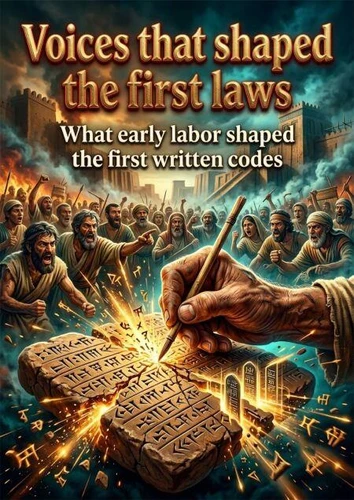
Voices that shaped the first laws. What early labor shaped the first written codes
Par :Formats :
Disponible dans votre compte client Decitre ou Furet du Nord dès validation de votre commande. Le format ePub est :
- Compatible avec une lecture sur My Vivlio (smartphone, tablette, ordinateur)
- Compatible avec une lecture sur liseuses Vivlio
- Pour les liseuses autres que Vivlio, vous devez utiliser le logiciel Adobe Digital Edition. Non compatible avec la lecture sur les liseuses Kindle, Remarkable et Sony
 , qui est-ce ?
Notre partenaire de plateforme de lecture numérique où vous retrouverez l'ensemble de vos ebooks gratuitement
Pour en savoir plus sur nos ebooks, consultez notre aide en ligne ici
C'est si simple ! Lisez votre ebook avec l'app Vivlio sur votre tablette, mobile ou ordinateur :

- Nombre de pages188
- FormatePub
- ISBN978-3-565-59156-5
- EAN9783565591565
- Date de parution27/07/2026
- Protection num.pas de protection
- Taille1 Mo
- Infos supplémentairesepub
- ÉditeurEmphaloz Publishing House
Résumé
Long before Hammurabi chiseled his code into diorite, the cities of Mesopotamia were already wrestling with a profound question: how does a society govern itself when no single ruler commands absolute authority? This book traces the emergence of legal thought, bureaucratic order, and institutional power across the fertile crescent, from the first temple records of Uruk to the imperial ambitions of Babylon.
It argues that the true cradle of civilization was not agriculture or metallurgy alone, but the slow and often brutal invention of systems that could manage people at scale. Through the lens of administrative tablets, temple accounts, and early legal compilations, the narrative reveals how writing itself became a tool of control and a foundation for justice. The reader moves through the rise of the city-state, the codification of social hierarchy, and the priestly negotiation of divine will against human need.
Each chapter examines a moment when order was imposed, resisted, or reimagined. The final sections consider how these ancient experiments in governance shaped the political DNA of later empires from Rome to Baghdad. This is not a survey of kings and battles, but a study of the quiet machinery of civilization: the ledger, the decree, the oath, and the court. For readers interested in the origins of law, statecraft, and the deep history of institutional power, this book offers a grounded and sobering look at what it cost to build a world that could be ruled by words.
It argues that the true cradle of civilization was not agriculture or metallurgy alone, but the slow and often brutal invention of systems that could manage people at scale. Through the lens of administrative tablets, temple accounts, and early legal compilations, the narrative reveals how writing itself became a tool of control and a foundation for justice. The reader moves through the rise of the city-state, the codification of social hierarchy, and the priestly negotiation of divine will against human need.
Each chapter examines a moment when order was imposed, resisted, or reimagined. The final sections consider how these ancient experiments in governance shaped the political DNA of later empires from Rome to Baghdad. This is not a survey of kings and battles, but a study of the quiet machinery of civilization: the ledger, the decree, the oath, and the court. For readers interested in the origins of law, statecraft, and the deep history of institutional power, this book offers a grounded and sobering look at what it cost to build a world that could be ruled by words.