
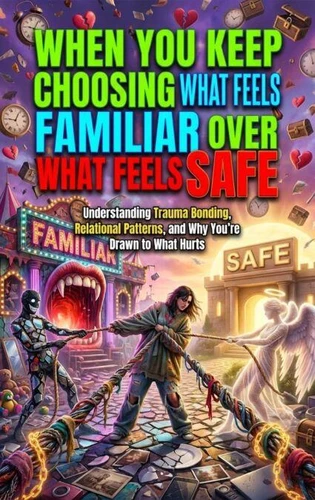
When You Keep Choosing What Feels Familiar Over What Feels Safe. Understanding Trauma Bonding, Relational Patterns, and Why You're Drawn to What Hurts
Par :Formats :
Disponible dans votre compte client Decitre ou Furet du Nord dès validation de votre commande. Le format ePub est :
- Compatible avec une lecture sur My Vivlio (smartphone, tablette, ordinateur)
- Compatible avec une lecture sur liseuses Vivlio
- Pour les liseuses autres que Vivlio, vous devez utiliser le logiciel Adobe Digital Edition. Non compatible avec la lecture sur les liseuses Kindle, Remarkable et Sony
 , qui est-ce ?
Notre partenaire de plateforme de lecture numérique où vous retrouverez l'ensemble de vos ebooks gratuitement
Pour en savoir plus sur nos ebooks, consultez notre aide en ligne ici
C'est si simple ! Lisez votre ebook avec l'app Vivlio sur votre tablette, mobile ou ordinateur :

- Nombre de pages157
- FormatePub
- ISBN978-3-565-19605-0
- EAN9783565196050
- Date de parution26/01/2026
- Protection num.pas de protection
- Taille2 Mo
- Infos supplémentairesepub
- ÉditeurEmphaloz Publishing House
Résumé
You know they're not good for you. You see the red flags, recognize the patterns, understand the cycle. But you stay anyway-or you leave and then find someone remarkably similar. Trauma doesn't just live in your past. It lives in who you're drawn to, how you attach, what feels like love even when it damages you.
This book explores how unresolved trauma shapes adult relationships in ways that feel invisible yet inevitable.
It examines why emotional unavailability can feel like home, how anxiety and avoidance create toxic push-pull dynamics, and why intensity gets mistaken for intimacy. It reframes repetitive relationship patterns not as bad choices or self-sabotage, but as your nervous system seeking what it knows-even when what it knows isn't safe. Rather than offering relationship advice or compatibility guidance, this book helps you understand the relational wiring created by early wounds.
It explores trauma bonding versus genuine connection, why you might confuse chaos with passion, and what it means to recognize familiar pain without letting it dictate who you choose. It's about seeing the pattern clearly enough to interrupt it. For anyone stuck in relationship cycles that repeat despite intentions to change, this book offers insight into why familiar feels compelling-and what needs to shift beneath behavior.
It examines why emotional unavailability can feel like home, how anxiety and avoidance create toxic push-pull dynamics, and why intensity gets mistaken for intimacy. It reframes repetitive relationship patterns not as bad choices or self-sabotage, but as your nervous system seeking what it knows-even when what it knows isn't safe. Rather than offering relationship advice or compatibility guidance, this book helps you understand the relational wiring created by early wounds.
It explores trauma bonding versus genuine connection, why you might confuse chaos with passion, and what it means to recognize familiar pain without letting it dictate who you choose. It's about seeing the pattern clearly enough to interrupt it. For anyone stuck in relationship cycles that repeat despite intentions to change, this book offers insight into why familiar feels compelling-and what needs to shift beneath behavior.
A propos de Sarah Whitfield














8,99 €