Sarah Whitfield is a nonfiction author who writes about history, culture, and the hidden stories behind social change. Her work combines accessible research with engaging storytelling, exploring how everyday lives are shaped by politics, tradition, and shifting historical events across different eras.
Nouveauté
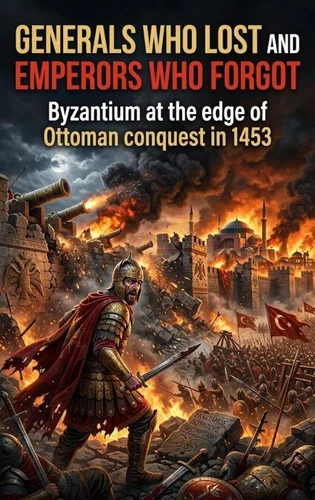
Generals Who Lost and Emperors Who Forgot. Byzantium at the edge of Ottoman conquest in 1453
Par :Formats :
Disponible dans votre compte client Decitre ou Furet du Nord dès validation de votre commande. Le format ePub est :
- Compatible avec une lecture sur My Vivlio (smartphone, tablette, ordinateur)
- Compatible avec une lecture sur liseuses Vivlio
- Pour les liseuses autres que Vivlio, vous devez utiliser le logiciel Adobe Digital Edition. Non compatible avec la lecture sur les liseuses Kindle, Remarkable et Sony
 , qui est-ce ?
Notre partenaire de plateforme de lecture numérique où vous retrouverez l'ensemble de vos ebooks gratuitement
Pour en savoir plus sur nos ebooks, consultez notre aide en ligne ici
C'est si simple ! Lisez votre ebook avec l'app Vivlio sur votre tablette, mobile ou ordinateur :

- Nombre de pages162
- FormatePub
- ISBN978-3-565-54536-0
- EAN9783565545360
- Date de parution08/07/2026
- Protection num.pas de protection
- Taille621 Ko
- Infos supplémentairesepub
- ÉditeurEmphaloz Publishing House
Résumé
The end came not with the breach of a wall but with the slow strangling of a world that had forgotten how to change. For weeks, the defenders of Constantinople watched the Ottoman navy drag ships overland, heard the mining beneath their feet, and felt the finality of a siege that offered no surrender with dignity. This account follows the last Byzantine emperor, Constantine XI, and the Genoese commander Giovanni Giustiniani as they faced not just an army but a historical logic that had turned against them.
It reveals how Mehmed II's conquest was less a military miracle than the culmination of a decade-long strategy that isolated the city from Western aid, exploited internal Byzantine divisions, and deployed gunpowder artillery with unprecedented coordination. The siege itself-fifty-three days of bombardment, naval blockade, and psychological warfare-exposed the fragility of medieval Christendom's eastern bulwark.
Beyond the tactics, the book examines what the fall meant for the Orthodox Church, the Greek diaspora, and the reshaping of trade routes from the Black Sea to the Mediterranean. The conquest of Constantinople was not merely the end of a city; it was the moment when the old order of Europe gave way to something harder, more centralized, and far less forgiving.
It reveals how Mehmed II's conquest was less a military miracle than the culmination of a decade-long strategy that isolated the city from Western aid, exploited internal Byzantine divisions, and deployed gunpowder artillery with unprecedented coordination. The siege itself-fifty-three days of bombardment, naval blockade, and psychological warfare-exposed the fragility of medieval Christendom's eastern bulwark.
Beyond the tactics, the book examines what the fall meant for the Orthodox Church, the Greek diaspora, and the reshaping of trade routes from the Black Sea to the Mediterranean. The conquest of Constantinople was not merely the end of a city; it was the moment when the old order of Europe gave way to something harder, more centralized, and far less forgiving.