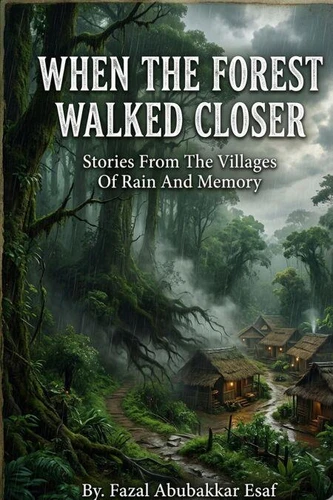
There are places where the boundary between the ordinary and the mysterious is very thin. In the hill villages of southern India, rain falls not merely as weather but as inheritance. Forests are spoken of as living beings. Rivers carry memory. Old houses keep grief in their courtyards. Certain paths are avoided after sunset not because anyone has seen danger, but because generations have agreed that silence itself deserves respect.
The stories in this collection emerge from such landscapes. These are not tales of grand kingdoms or heroic battles. They belong instead to drummers, widows, ferrymen, farmers, orphan girls, wandering monks, and children who follow fireflies into dark forests. Many of them stand at the edge of change - between old belief and modern certainty, between memory and forgetting, between the village and the forest slowly moving closer.
Though fictional, these stories are deeply rooted in the emotional truth of Malnad life: the intimacy with rain, the weight of caste and custom, the loneliness of abandoned houses, and the quiet persistence of wonder. If these pages carry any purpose, it is perhaps this: to listen carefully to the small voices often drowned by the noise of the world. Because sometimes, in the middle of a storm, the oldest stories speak again.
There are places where the boundary between the ordinary and the mysterious is very thin. In the hill villages of southern India, rain falls not merely as weather but as inheritance. Forests are spoken of as living beings. Rivers carry memory. Old houses keep grief in their courtyards. Certain paths are avoided after sunset not because anyone has seen danger, but because generations have agreed that silence itself deserves respect.
The stories in this collection emerge from such landscapes. These are not tales of grand kingdoms or heroic battles. They belong instead to drummers, widows, ferrymen, farmers, orphan girls, wandering monks, and children who follow fireflies into dark forests. Many of them stand at the edge of change - between old belief and modern certainty, between memory and forgetting, between the village and the forest slowly moving closer.
Though fictional, these stories are deeply rooted in the emotional truth of Malnad life: the intimacy with rain, the weight of caste and custom, the loneliness of abandoned houses, and the quiet persistence of wonder. If these pages carry any purpose, it is perhaps this: to listen carefully to the small voices often drowned by the noise of the world. Because sometimes, in the middle of a storm, the oldest stories speak again.

 , qui est-ce ?