
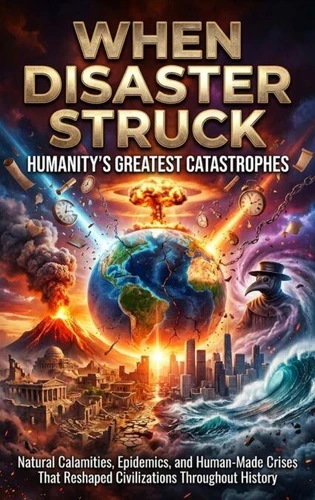
When Disaster Struck: Humanity's Greatest Catastrophes. Natural Calamities, Epidemics, and Human-Made Crises That Reshaped Civilizations Throughout History
Par :Formats :
Disponible dans votre compte client Decitre ou Furet du Nord dès validation de votre commande. Le format ePub est :
- Compatible avec une lecture sur My Vivlio (smartphone, tablette, ordinateur)
- Compatible avec une lecture sur liseuses Vivlio
- Pour les liseuses autres que Vivlio, vous devez utiliser le logiciel Adobe Digital Edition. Non compatible avec la lecture sur les liseuses Kindle, Remarkable et Sony
 , qui est-ce ?
Notre partenaire de plateforme de lecture numérique où vous retrouverez l'ensemble de vos ebooks gratuitement
Pour en savoir plus sur nos ebooks, consultez notre aide en ligne ici
C'est si simple ! Lisez votre ebook avec l'app Vivlio sur votre tablette, mobile ou ordinateur :

- Nombre de pages263
- FormatePub
- ISBN978-3-565-24938-1
- EAN9783565249381
- Date de parution15/02/2026
- Protection num.pas de protection
- Taille2 Mo
- Infos supplémentairesepub
- ÉditeurEmphaloz Publishing House
Résumé
Catastrophic events expose the vulnerabilities of human societies while revealing capacities for resilience, adaptation, and institutional transformation. This comprehensive examination analyzes major disasters across history-from volcanic eruptions and earthquakes through plague pandemics and famines to industrial accidents and environmental collapse-exploring not just their immediate devastation but their long-term social, economic, and political consequences.
Drawing on archaeological evidence, medical records, government reports, and survivor testimonies, this book reveals how disasters interact with existing inequalities, how societies organize relief and reconstruction, and how catastrophes trigger institutional reforms or social upheaval.
It explores why similar events produce different outcomes depending on governance structures, resource distribution, and cultural responses to crisis. The narrative examines how communities maintained social cohesion or fractured under extreme stress, how authorities maintained legitimacy or lost credibility through crisis management, and how disasters accelerated changes already underway or created genuinely new historical trajectories.
It analyzes the relationship between disaster vulnerability and social organization, how knowledge from past catastrophes was preserved or forgotten, and what survival patterns reveal about human adaptability. Without sensationalism, this work provides rigorous analysis of how catastrophes shape human history and what they teach about societal resilience.
It explores why similar events produce different outcomes depending on governance structures, resource distribution, and cultural responses to crisis. The narrative examines how communities maintained social cohesion or fractured under extreme stress, how authorities maintained legitimacy or lost credibility through crisis management, and how disasters accelerated changes already underway or created genuinely new historical trajectories.
It analyzes the relationship between disaster vulnerability and social organization, how knowledge from past catastrophes was preserved or forgotten, and what survival patterns reveal about human adaptability. Without sensationalism, this work provides rigorous analysis of how catastrophes shape human history and what they teach about societal resilience.
A propos de Sarah Whitfield












8,99 €