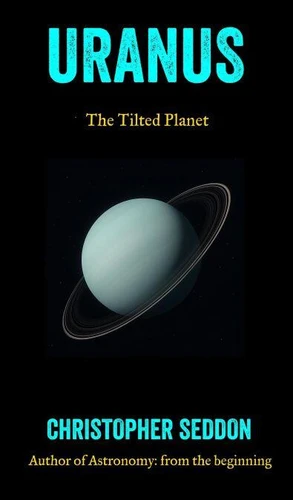
Uranus: the Tilted Planet. A Short Guide to the Planets, #6
Par :Formats :
Disponible dans votre compte client Decitre ou Furet du Nord dès validation de votre commande. Le format ePub est :
- Compatible avec une lecture sur My Vivlio (smartphone, tablette, ordinateur)
- Compatible avec une lecture sur liseuses Vivlio
- Pour les liseuses autres que Vivlio, vous devez utiliser le logiciel Adobe Digital Edition. Non compatible avec la lecture sur les liseuses Kindle, Remarkable et Sony
 , qui est-ce ?
Notre partenaire de plateforme de lecture numérique où vous retrouverez l'ensemble de vos ebooks gratuitement
Pour en savoir plus sur nos ebooks, consultez notre aide en ligne ici
C'est si simple ! Lisez votre ebook avec l'app Vivlio sur votre tablette, mobile ou ordinateur :

- FormatePub
- ISBN978-1-9162964-8-0
- EAN9781916296480
- Date de parution05/06/2026
- Protection num.pas de protection
- Infos supplémentairesepub
- ÉditeurChristopher Seddon
Résumé
A concise history of Uranus in a 12, 000 work eBook short read. Uranus is the first 'modern' planet, not having been discovered until 1781. Despite this, it is visible to the naked eye and possible sightings go back to the second century BCE - but all these early observers thought that it was nothing more than a faint star. Even its discoverer, German-born British astronomer William Herschel, thought that he had simply found a new comet.
Uranus was the second planet found to possess a ring system. Its rings are much fainter than those of Saturn, and were not discovered until 1977 - but did Herschel spot them almost two hundred years earlier?Like it's near-twin Neptune, Uranus is now thought of as an 'ice giant' and not just a smaller version of Jupiter or Saturn. Unlike Neptune, its extreme axial tilt of more than 90° suggests that the planet was literally knocked sideways by a giant impact early in its history.
Uranus was the second planet found to possess a ring system. Its rings are much fainter than those of Saturn, and were not discovered until 1977 - but did Herschel spot them almost two hundred years earlier?Like it's near-twin Neptune, Uranus is now thought of as an 'ice giant' and not just a smaller version of Jupiter or Saturn. Unlike Neptune, its extreme axial tilt of more than 90° suggests that the planet was literally knocked sideways by a giant impact early in its history.