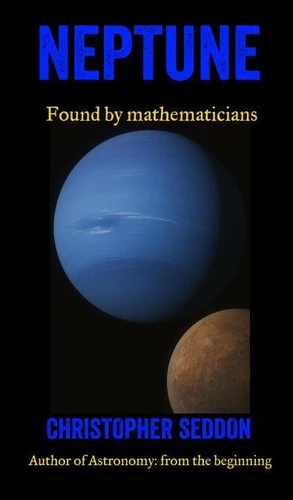
Neptune: Found by Mathematicians. A Short Guide to the Planets, #7
Par :Formats :
Disponible dans votre compte client Decitre ou Furet du Nord dès validation de votre commande. Le format ePub est :
- Compatible avec une lecture sur My Vivlio (smartphone, tablette, ordinateur)
- Compatible avec une lecture sur liseuses Vivlio
- Pour les liseuses autres que Vivlio, vous devez utiliser le logiciel Adobe Digital Edition. Non compatible avec la lecture sur les liseuses Kindle, Remarkable et Sony
 , qui est-ce ?
Notre partenaire de plateforme de lecture numérique où vous retrouverez l'ensemble de vos ebooks gratuitement
Pour en savoir plus sur nos ebooks, consultez notre aide en ligne ici
C'est si simple ! Lisez votre ebook avec l'app Vivlio sur votre tablette, mobile ou ordinateur :

- FormatePub
- ISBN978-1-9162964-9-7
- EAN9781916296497
- Date de parution05/06/2026
- Protection num.pas de protection
- Infos supplémentairesepub
- ÉditeurChristopher Seddon
Résumé
This 12, 000 work eBook short read tells the story of Neptune's discovery and what we have learned in the 180 years since then. Neptune was discovered in 1846 after two mathematicians - John Couch Adams and Urbain Le Verrier - independently predicted that only the existence of an undiscovered planet beyond the orbit of Uranus could explain the latter's puzzling behaviour. Following Pluto's demotion, this distant planet has regained its place as the Solar System's outermost planet; a world so remote that despite being many times larger than Earth, it can never be seen with the naked eye.
Although Neptune is a near-twin of Uranus, it is not an identical twin. It is larger, less dense, and lacks Uranus's extreme axial tilt. Despite its serene appearance, it hosts some of the most violent weather in the Solar System, with windspeeds of up to 900 miles per hour. Neptune also hosts the Solar System's largest retrograde moon - Triton, captured from the distant Kuiper belt, is only slightly smaller than our own Moon.
Despite this, its retrograde orbit means that it is slowly spiralling to destruction.
Although Neptune is a near-twin of Uranus, it is not an identical twin. It is larger, less dense, and lacks Uranus's extreme axial tilt. Despite its serene appearance, it hosts some of the most violent weather in the Solar System, with windspeeds of up to 900 miles per hour. Neptune also hosts the Solar System's largest retrograde moon - Triton, captured from the distant Kuiper belt, is only slightly smaller than our own Moon.
Despite this, its retrograde orbit means that it is slowly spiralling to destruction.