
Author of English-language books on mindset mastery, business innovation, and historical narratives. Elena guides readers toward clarity and achievement by connecting ancient wisdom with contemporary challenges.
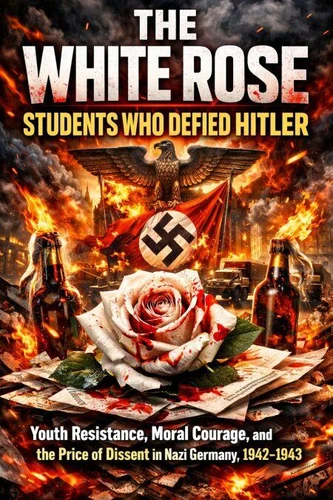
The White Rose: Students Who Defied Hitler. Youth Resistance, Moral Courage, and the Price of Dissent in Nazi Germany, 1942–1943
Par :Formats :
Disponible dans votre compte client Decitre ou Furet du Nord dès validation de votre commande. Le format ePub est :
- Compatible avec une lecture sur My Vivlio (smartphone, tablette, ordinateur)
- Compatible avec une lecture sur liseuses Vivlio
- Pour les liseuses autres que Vivlio, vous devez utiliser le logiciel Adobe Digital Edition. Non compatible avec la lecture sur les liseuses Kindle, Remarkable et Sony
 , qui est-ce ?
Notre partenaire de plateforme de lecture numérique où vous retrouverez l'ensemble de vos ebooks gratuitement
Pour en savoir plus sur nos ebooks, consultez notre aide en ligne ici
C'est si simple ! Lisez votre ebook avec l'app Vivlio sur votre tablette, mobile ou ordinateur :

- Nombre de pages198
- FormatePub
- ISBN978-3-565-32482-8
- EAN9783565324828
- Date de parution14/03/2026
- Protection num.pas de protection
- Taille3 Mo
- Infos supplémentairesepub
- ÉditeurEmphaloz Publishing House
Résumé
In the winter of 1942, a small group of university students in Munich began distributing leaflets calling on ordinary Germans to resist the Nazi regime. They were not soldiers, politicians, or seasoned operatives. Hans and Sophie Scholl, Alexander Schmorell, Christoph Probst, and their circle were young men and women in their early twenties - medical students, philosophy readers, people of religious conviction - who had concluded that silence was no longer morally permissible.
Within months of their final leaflet distribution, they were arrested, tried before the People's Court under Roland Freisler, and executed by guillotine. This book reconstructs the White Rose through Gestapo interrogation records, trial transcripts, surviving correspondence, personal diaries, and the testimonies of those who knew them. It examines how these students arrived at resistance - the religious and philosophical influences that shaped their moral framework, the disillusionment that followed early enthusiasm for National Socialism, and the practical decisions involved in producing and distributing resistance literature inside a surveillance state. The narrative also examines what the White Rose reveals about the structural conditions of dissent under totalitarianism: how isolated individual conscience operates without institutional support, how the regime's judicial apparatus was designed to eliminate not just resisters but the memory of resistance, and how postwar Germany eventually constructed the White Rose into a national symbol of moral courage. A carefully documented account of young people who chose conscience over survival - and what that choice cost them.
Within months of their final leaflet distribution, they were arrested, tried before the People's Court under Roland Freisler, and executed by guillotine. This book reconstructs the White Rose through Gestapo interrogation records, trial transcripts, surviving correspondence, personal diaries, and the testimonies of those who knew them. It examines how these students arrived at resistance - the religious and philosophical influences that shaped their moral framework, the disillusionment that followed early enthusiasm for National Socialism, and the practical decisions involved in producing and distributing resistance literature inside a surveillance state. The narrative also examines what the White Rose reveals about the structural conditions of dissent under totalitarianism: how isolated individual conscience operates without institutional support, how the regime's judicial apparatus was designed to eliminate not just resisters but the memory of resistance, and how postwar Germany eventually constructed the White Rose into a national symbol of moral courage. A carefully documented account of young people who chose conscience over survival - and what that choice cost them.
A propos de Elena Brooks













0,99 €