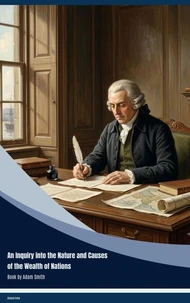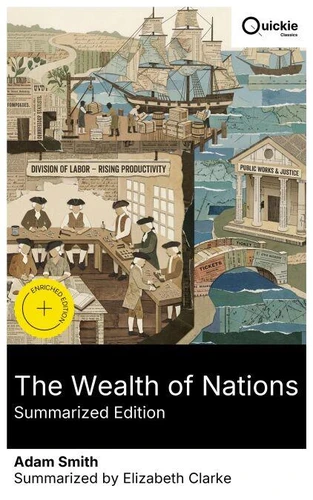
The Wealth of Nations (Summarized Edition). Enriched edition. Classical economics on division of labor, productivity, and free markets, challenging mercantilist and physiocratic doctrines of the era
Par : ,Formats :
Disponible dans votre compte client Decitre ou Furet du Nord dès validation de votre commande. Le format ePub est :
- Compatible avec une lecture sur My Vivlio (smartphone, tablette, ordinateur)
- Compatible avec une lecture sur liseuses Vivlio
- Pour les liseuses autres que Vivlio, vous devez utiliser le logiciel Adobe Digital Edition. Non compatible avec la lecture sur les liseuses Kindle, Remarkable et Sony
 , qui est-ce ?
Notre partenaire de plateforme de lecture numérique où vous retrouverez l'ensemble de vos ebooks gratuitement
Pour en savoir plus sur nos ebooks, consultez notre aide en ligne ici
C'est si simple ! Lisez votre ebook avec l'app Vivlio sur votre tablette, mobile ou ordinateur :

- Nombre de pages299
- FormatePub
- ISBN859-65--4788335-7
- EAN8596547883357
- Date de parution10/01/2026
- Protection num.Digital Watermarking
- Taille1 Mo
- Infos supplémentairesepub
- ÉditeurQUICKIE CLASSICS
Résumé
First published in 1776, The Wealth of Nations advances a sweeping analysis of commercial society. Smith dissects the division of labor-famously, the pin factory-distinguishes natural from market prices, and traces capital, money, and trade. In lucid Enlightenment prose, he dismantles mercantilism, argues for freer commerce, and delineates limited public functions-defense, justice, infrastructure-founding classical political economy while grounding theory in historical examples and institutional detail.
Adam Smith (1723-1790), Scotland's leading moral philosopher and Glasgow professor, carried into this work insights from The Theory of Moral Sentiments and a lifelong dialogue with David Hume. Travels in France while tutoring the Duke of Buccleuch brought him to the physiocrats, especially Quesnay and Turgot, sharpening his empirical method and his conviction that secure property and impartial justice foster prosperity.
For readers of economic policy, intellectual history, or the ethics of markets, this book remains indispensable. It rewards careful study not as a brief for unbounded laissez-faire but as a nuanced blueprint that balances liberty with institutions. Students, policymakers, and reflective citizens will find lasting tools to think clearly about growth, taxation, trade, and the state. Quickie Classics summarizes timeless works with precision, preserving the author's voice and keeping the prose clear, fast, and readable-distilled, never diluted.
Enriched Edition extras: Introduction · Synopsis · Historical Context · Author Biography · Brief Analysis · 4 Reflection Q&As · Editorial Footnotes.
Adam Smith (1723-1790), Scotland's leading moral philosopher and Glasgow professor, carried into this work insights from The Theory of Moral Sentiments and a lifelong dialogue with David Hume. Travels in France while tutoring the Duke of Buccleuch brought him to the physiocrats, especially Quesnay and Turgot, sharpening his empirical method and his conviction that secure property and impartial justice foster prosperity.
For readers of economic policy, intellectual history, or the ethics of markets, this book remains indispensable. It rewards careful study not as a brief for unbounded laissez-faire but as a nuanced blueprint that balances liberty with institutions. Students, policymakers, and reflective citizens will find lasting tools to think clearly about growth, taxation, trade, and the state. Quickie Classics summarizes timeless works with precision, preserving the author's voice and keeping the prose clear, fast, and readable-distilled, never diluted.
Enriched Edition extras: Introduction · Synopsis · Historical Context · Author Biography · Brief Analysis · 4 Reflection Q&As · Editorial Footnotes.