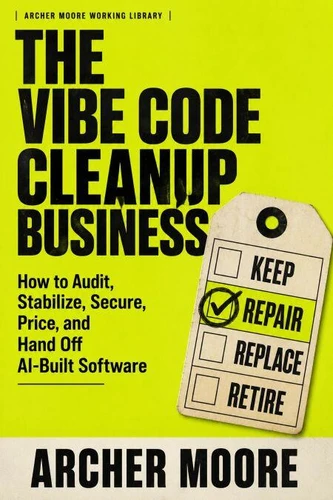
The prototype is live. Customers can sign in. Records are accumulating. A payment integration works on the happy path. The founder now needs someone else to maintain it-and nobody can say exactly which branch reached production, which services hold the data, whether backups restore, where the secrets live, or what will break during the next change. The Vibe Code Cleanup Business begins at that transition.
It is not another guide to generating an app from prompts. It is a practical operating manual for the developer, consultant, or technical generalist who must decide whether an already-built system should be kept, repaired, replaced, or retired. The book covers client qualification, paid inspections, scopes and prices, safe access, company-owned accounts, clean reproduction, system and dependency inventories, user and data tracing, critical-path tests, generated-code conditions, security, permissions, failure paths, cost, accessibility, abuse, release, rollback, backup restore, acceptance, offboarding, and maintenance.
Sixteen field-ready appendices turn the method into an intake, inspection, repair, handoff, and referral practice. The promised result is not prettier code or a claim of perfect security. It is control: a documented system, a tested disposition, a bounded repair order, a repeatable release and recovery route, and a handoff the next maintainer does not have to reconstruct from zero.
The prototype is live. Customers can sign in. Records are accumulating. A payment integration works on the happy path. The founder now needs someone else to maintain it-and nobody can say exactly which branch reached production, which services hold the data, whether backups restore, where the secrets live, or what will break during the next change. The Vibe Code Cleanup Business begins at that transition.
It is not another guide to generating an app from prompts. It is a practical operating manual for the developer, consultant, or technical generalist who must decide whether an already-built system should be kept, repaired, replaced, or retired. The book covers client qualification, paid inspections, scopes and prices, safe access, company-owned accounts, clean reproduction, system and dependency inventories, user and data tracing, critical-path tests, generated-code conditions, security, permissions, failure paths, cost, accessibility, abuse, release, rollback, backup restore, acceptance, offboarding, and maintenance.
Sixteen field-ready appendices turn the method into an intake, inspection, repair, handoff, and referral practice. The promised result is not prettier code or a claim of perfect security. It is control: a documented system, a tested disposition, a bounded repair order, a repeatable release and recovery route, and a handoff the next maintainer does not have to reconstruct from zero.

 , qui est-ce ?