SOLDES
Jusqu'à -70% sur une sélection d'articles*

Nouveauté
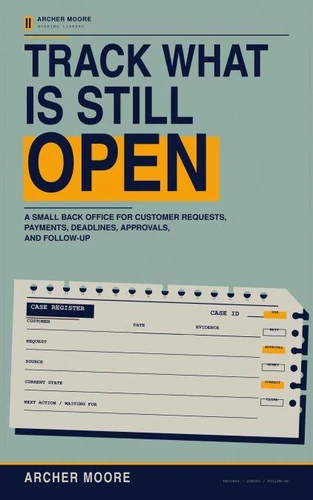
Track What Is Still Open: A Small Back Office for Customer Requests, Payments, Deadlines, Approvals, and Follow-Up
Par :Formats :
Disponible dans votre compte client Decitre ou Furet du Nord dès validation de votre commande. Le format ePub est :
- Compatible avec une lecture sur My Vivlio (smartphone, tablette, ordinateur)
- Compatible avec une lecture sur liseuses Vivlio
- Pour les liseuses autres que Vivlio, vous devez utiliser le logiciel Adobe Digital Edition. Non compatible avec la lecture sur les liseuses Kindle, Remarkable et Sony
 , qui est-ce ?
Notre partenaire de plateforme de lecture numérique où vous retrouverez l'ensemble de vos ebooks gratuitement
Pour en savoir plus sur nos ebooks, consultez notre aide en ligne ici
C'est si simple ! Lisez votre ebook avec l'app Vivlio sur votre tablette, mobile ou ordinateur :

- FormatePub
- ISBN8235026551
- EAN9798235026551
- Date de parution13/07/2026
- Protection num.pas de protection
- Infos supplémentairesepub
- ÉditeurIoakim Ioakim
Résumé
You know how to do the work. The trouble is keeping every open promise visible when a request starts in email, a deadline lands on a calendar, approval arrives by text, an invoice sits in a folder, and payment appears in another app. Track What Is Still Open shows how to gather that scattered work into a small back office you can inspect, maintain, export, and recover. The method starts with one case register.
Each open job gets a stable ID, source, current state, next action, date, evidence links, and history. From that register, you build separate views for work due now, work waiting on someone else, approvals, unresolved payments, corrections, and cases ready to close. Use the book to: Inventory every place work enters. Separate source facts, interpretations, decisions, and actions. Define states with clear entry and exit tests.
Control follow-up without using sent mail as a waiting list. Match payments to the right invoice, job, refund, or deposit. Preserve who approved what, for which version, and where the evidence lives. Run daily, weekly, and monthly reviews. Compare paper, spreadsheets, small databases, and paid software. Test exports, backups, recovery, and exit. Use AI for comparison, extraction, summaries, and drafts while a person controls access, approval, and action.
Define a small result a buyer can inspect, perform the work manually, test demand, and decide whether software is justified. Every chapter provides an inspection, worksheet, decision rule, evidence threshold, or stop condition. Hypothetical examples are labeled. Local laws, prices, permissions, and professional requirements remain yours to investigate. The method does not rely on made-up case histories or promise that the business will run itself.
This book is for solo service operators, consultants, contractors, independent builders, small process owners, and the person who knows which spreadsheet actually runs the work. Build a back office that shows what is open, what is blocked, and what must happen next.
Each open job gets a stable ID, source, current state, next action, date, evidence links, and history. From that register, you build separate views for work due now, work waiting on someone else, approvals, unresolved payments, corrections, and cases ready to close. Use the book to: Inventory every place work enters. Separate source facts, interpretations, decisions, and actions. Define states with clear entry and exit tests.
Control follow-up without using sent mail as a waiting list. Match payments to the right invoice, job, refund, or deposit. Preserve who approved what, for which version, and where the evidence lives. Run daily, weekly, and monthly reviews. Compare paper, spreadsheets, small databases, and paid software. Test exports, backups, recovery, and exit. Use AI for comparison, extraction, summaries, and drafts while a person controls access, approval, and action.
Define a small result a buyer can inspect, perform the work manually, test demand, and decide whether software is justified. Every chapter provides an inspection, worksheet, decision rule, evidence threshold, or stop condition. Hypothetical examples are labeled. Local laws, prices, permissions, and professional requirements remain yours to investigate. The method does not rely on made-up case histories or promise that the business will run itself.
This book is for solo service operators, consultants, contractors, independent builders, small process owners, and the person who knows which spreadsheet actually runs the work. Build a back office that shows what is open, what is blocked, and what must happen next.