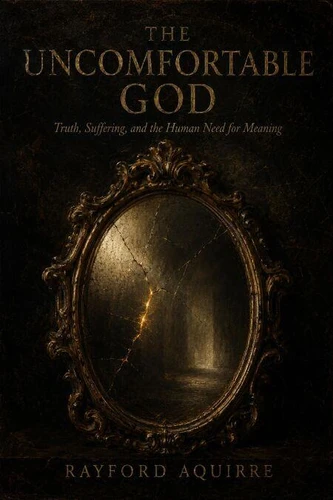
What if the stories that help us survive suffering also prevent us from seeing it clearly?Human beings do not merely experience events - we interpret them. We call tragedy a test, recovery a blessing, injustice a lesson, and history a plan. Meaning can sustain us. It can also distort reality, silence grief, excuse cruelty, and turn hope into certainty. The Uncomfortable God is a philosophical and interdisciplinary exploration of truth, suffering, belief, and the human need for meaning.
Moving through theology, psychology, ethics, grief, trauma, mysticism, atheism, and the problem of evil, Rayford Aquirre asks a difficult question:How can we seek meaning without falsifying what happened, diminishing those who suffer, or escaping our responsibility to act?This is not an argument for belief or unbelief. It is an inquiry into the difference between fact, interpretation, hope, and projection - and into the moral consequences of confusing them.
With intellectual rigor and poetic force, the book examines:why consolation can heal - and when it becomes harmful;how belief in justice can lead to victim-blaming;what religion, philosophy, and science can honestly claim;how different traditions confront divine silence and human pain;whether responsibility can survive without certainty;and what mature hope might look like when no final explanation is guaranteed.
The Uncomfortable God offers no easy answers. Instead, it invites readers into a more demanding form of honesty: one that allows grief to speak, uncertainty to remain, and responsibility to begin before meaning is secure. A serious, searching book for believers, doubters, skeptics, philosophers, caregivers, and anyone who has ever asked why - and refused to accept a comforting answer too quickly.
What if the stories that help us survive suffering also prevent us from seeing it clearly?Human beings do not merely experience events - we interpret them. We call tragedy a test, recovery a blessing, injustice a lesson, and history a plan. Meaning can sustain us. It can also distort reality, silence grief, excuse cruelty, and turn hope into certainty. The Uncomfortable God is a philosophical and interdisciplinary exploration of truth, suffering, belief, and the human need for meaning.
Moving through theology, psychology, ethics, grief, trauma, mysticism, atheism, and the problem of evil, Rayford Aquirre asks a difficult question:How can we seek meaning without falsifying what happened, diminishing those who suffer, or escaping our responsibility to act?This is not an argument for belief or unbelief. It is an inquiry into the difference between fact, interpretation, hope, and projection - and into the moral consequences of confusing them.
With intellectual rigor and poetic force, the book examines:why consolation can heal - and when it becomes harmful;how belief in justice can lead to victim-blaming;what religion, philosophy, and science can honestly claim;how different traditions confront divine silence and human pain;whether responsibility can survive without certainty;and what mature hope might look like when no final explanation is guaranteed.
The Uncomfortable God offers no easy answers. Instead, it invites readers into a more demanding form of honesty: one that allows grief to speak, uncertainty to remain, and responsibility to begin before meaning is secure. A serious, searching book for believers, doubters, skeptics, philosophers, caregivers, and anyone who has ever asked why - and refused to accept a comforting answer too quickly.


 , qui est-ce ?