He was absolutely sure. He was absolutely wrong. On a Tuesday in March, Rayford Aquirre looked the woman he loved in the eye and said, "I know." He had assembled the evidence-text messages, timestamps, a pattern that proved beyond doubt that she had betrayed him. The certainty felt like clarity. It felt like truth. It was a feeling, and the feeling lied. She left. Not because of the betrayal he accused her of, but because of the betrayal he committed when he mistook his own manufactured certainty for knowledge.
That destruction sent Aquirre on a seven-year journey into the architecture of human error. He sat in courtrooms where confident witnesses pointed at innocent men. He stood in hospital corridors where serene doctors delivered diagnoses that autopsies later disproved. He interviewed traders who lost everything betting on their own certainty, politicians who mobilized mobs with unshakable confidence in lies, and soldiers who fired on children because they were "one hundred percent sure" they saw a weapon.
He met cult survivors, con artists, propagandists, and corporate executives who all understood the same terrifying thing: confidence is not a measure of knowledge. It is a weapon. And most of us do not know we are armed. Drawing on decades of peer-reviewed research in neuroscience, psychology, and behavioral economics, The Certainty Trap reveals the hidden machinery of false conviction. Using fMRI studies, Aquirre shows how the brain processes confidence and accuracy through separate neural circuits-the dopamine-rich ventral striatum that rewards the feeling of knowing, and the memory systems that track what actually happened.
Under pristine laboratory conditions, confidence correlates with accuracy. But in the courtroom, the hospital, the trading floor, the war room, and the bedroom, five predictable conditions decouple them: time delay, social feedback, emotional stakes, institutional incentives, and repeated exposure. When these converge, certainty becomes a trap-and we are all caught in it. From the eyewitness misidentifications that drive the majority of DNA exonerations, to the diagnostic overconfidence that kills patients in silence, to the corporate confidence machines that promote theater over truth, to the political propaganda that weaponizes our hunger for certainty itself, Aquirre traces how a social dominance signal evolved for savanna survival has become catastrophically misfit for nuclear diplomacy, financial derivatives, criminal justice, and intimate love.
This is not a self-help book. It offers no techniques to sell, no power poses to practice, no confidence to calibrate. It is a witness report from inside the trap. The only defense Aquirre offers is the knowledge that the trap exists-to feel it pulling, to recognize its mechanisms, and to refuse, one breath at a time, to mistake the feeling of knowledge for knowledge itself. Because the question is not whether you have been caught in the certainty trap.
The question is whether you know you are in it.
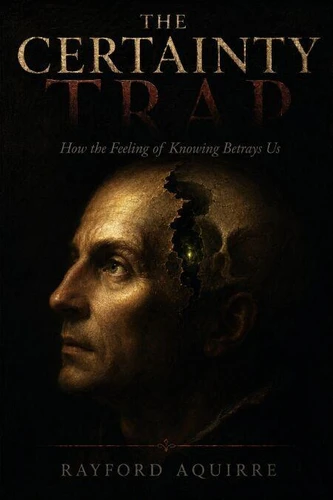
He was absolutely sure. He was absolutely wrong. On a Tuesday in March, Rayford Aquirre looked the woman he loved in the eye and said, "I know." He had assembled the evidence-text messages, timestamps, a pattern that proved beyond doubt that she had betrayed him. The certainty felt like clarity. It felt like truth. It was a feeling, and the feeling lied. She left. Not because of the betrayal he accused her of, but because of the betrayal he committed when he mistook his own manufactured certainty for knowledge.
That destruction sent Aquirre on a seven-year journey into the architecture of human error. He sat in courtrooms where confident witnesses pointed at innocent men. He stood in hospital corridors where serene doctors delivered diagnoses that autopsies later disproved. He interviewed traders who lost everything betting on their own certainty, politicians who mobilized mobs with unshakable confidence in lies, and soldiers who fired on children because they were "one hundred percent sure" they saw a weapon.
He met cult survivors, con artists, propagandists, and corporate executives who all understood the same terrifying thing: confidence is not a measure of knowledge. It is a weapon. And most of us do not know we are armed. Drawing on decades of peer-reviewed research in neuroscience, psychology, and behavioral economics, The Certainty Trap reveals the hidden machinery of false conviction. Using fMRI studies, Aquirre shows how the brain processes confidence and accuracy through separate neural circuits-the dopamine-rich ventral striatum that rewards the feeling of knowing, and the memory systems that track what actually happened.
Under pristine laboratory conditions, confidence correlates with accuracy. But in the courtroom, the hospital, the trading floor, the war room, and the bedroom, five predictable conditions decouple them: time delay, social feedback, emotional stakes, institutional incentives, and repeated exposure. When these converge, certainty becomes a trap-and we are all caught in it. From the eyewitness misidentifications that drive the majority of DNA exonerations, to the diagnostic overconfidence that kills patients in silence, to the corporate confidence machines that promote theater over truth, to the political propaganda that weaponizes our hunger for certainty itself, Aquirre traces how a social dominance signal evolved for savanna survival has become catastrophically misfit for nuclear diplomacy, financial derivatives, criminal justice, and intimate love.
This is not a self-help book. It offers no techniques to sell, no power poses to practice, no confidence to calibrate. It is a witness report from inside the trap. The only defense Aquirre offers is the knowledge that the trap exists-to feel it pulling, to recognize its mechanisms, and to refuse, one breath at a time, to mistake the feeling of knowledge for knowledge itself. Because the question is not whether you have been caught in the certainty trap.
The question is whether you know you are in it.


 , qui est-ce ?