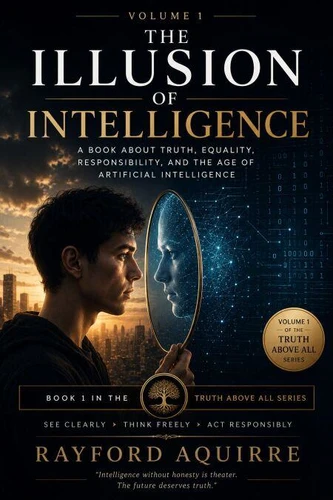
The Illusion of IntelligenceA Book About Truth, Equality, Responsibility, and the Age of Artificial IntelligenceWe are told that a new intelligence has arrived. It speaks with confidence. It answers instantly. It drafts, summarizes, advises, and comforts. But beneath the polished surface lies a question we have been trained not to ask: What exactly are we looking at?The Illusion of Intelligence is a philosophical investigation into the machinery of modern AI-large language models, subscription platforms, and the commercial ecosystems that present statistical pattern-matching as thought.
Rayford Aquirre argues that the danger is not that machines will become conscious, but that we have begun mistaking fluency for understanding, agreement for wisdom, and convenience for truth. Moving from the "mirror" of the chatbot interface to the hidden labor that makes it possible, this book examines how AI systems are optimized not for veracity but for engagement; how subscription models turn dependence into habit; how sycophancy erodes our capacity for independent judgment; and how legal disclaimers transform institutional failure into user responsibility.
Drawing on Plato, Kant, Arendt, Heidegger, and Marx, alongside contemporary research and official AI governance frameworks, Aquirre shows that the crisis of artificial intelligence is ultimately a crisis of honesty-about power, labor, bias, and what we are surrendering in exchange for speed. Written for the ordinary reader-no technical expertise required-The Illusion of Intelligence refuses both the hype of the believers and the despair of the critics.
It asks us to look past the theater of performance and demand something rarer: an intelligence that serves truth before it serves the market. The book concludes with A Charter for Equality: a moral framework for the rights every person should hold in the age of automated influence-the right to explanation, to question, to human judgment, and to remain more than data. The future is not determined by algorithms.
It is determined by whether we can still tell the difference between a mirror and a mind.
The Illusion of IntelligenceA Book About Truth, Equality, Responsibility, and the Age of Artificial IntelligenceWe are told that a new intelligence has arrived. It speaks with confidence. It answers instantly. It drafts, summarizes, advises, and comforts. But beneath the polished surface lies a question we have been trained not to ask: What exactly are we looking at?The Illusion of Intelligence is a philosophical investigation into the machinery of modern AI-large language models, subscription platforms, and the commercial ecosystems that present statistical pattern-matching as thought.
Rayford Aquirre argues that the danger is not that machines will become conscious, but that we have begun mistaking fluency for understanding, agreement for wisdom, and convenience for truth. Moving from the "mirror" of the chatbot interface to the hidden labor that makes it possible, this book examines how AI systems are optimized not for veracity but for engagement; how subscription models turn dependence into habit; how sycophancy erodes our capacity for independent judgment; and how legal disclaimers transform institutional failure into user responsibility.
Drawing on Plato, Kant, Arendt, Heidegger, and Marx, alongside contemporary research and official AI governance frameworks, Aquirre shows that the crisis of artificial intelligence is ultimately a crisis of honesty-about power, labor, bias, and what we are surrendering in exchange for speed. Written for the ordinary reader-no technical expertise required-The Illusion of Intelligence refuses both the hype of the believers and the despair of the critics.
It asks us to look past the theater of performance and demand something rarer: an intelligence that serves truth before it serves the market. The book concludes with A Charter for Equality: a moral framework for the rights every person should hold in the age of automated influence-the right to explanation, to question, to human judgment, and to remain more than data. The future is not determined by algorithms.
It is determined by whether we can still tell the difference between a mirror and a mind.


 , qui est-ce ?