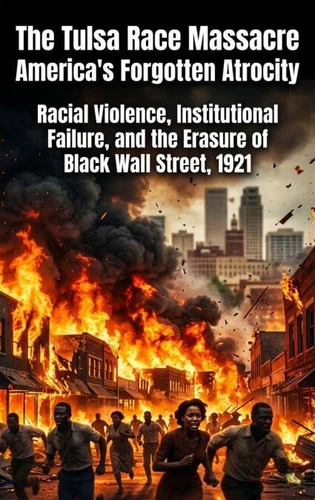
The Tulsa Race Massacre: America's Forgotten Atrocity. Racial Violence, Institutional Failure, and the Erasure of Black Wall Street, 1921
Par :Formats :
Disponible dans votre compte client Decitre ou Furet du Nord dès validation de votre commande. Le format ePub est :
- Compatible avec une lecture sur My Vivlio (smartphone, tablette, ordinateur)
- Compatible avec une lecture sur liseuses Vivlio
- Pour les liseuses autres que Vivlio, vous devez utiliser le logiciel Adobe Digital Edition. Non compatible avec la lecture sur les liseuses Kindle, Remarkable et Sony
 , qui est-ce ?
Notre partenaire de plateforme de lecture numérique où vous retrouverez l'ensemble de vos ebooks gratuitement
Pour en savoir plus sur nos ebooks, consultez notre aide en ligne ici
C'est si simple ! Lisez votre ebook avec l'app Vivlio sur votre tablette, mobile ou ordinateur :

- Nombre de pages198
- FormatePub
- ISBN978-3-565-32664-8
- EAN9783565326648
- Date de parution15/03/2026
- Protection num.pas de protection
- Taille1 Mo
- Infos supplémentairesepub
- ÉditeurEmphaloz Publishing House
Résumé
On the night of May 31, 1921, one of the wealthiest Black communities in the United States was destroyed in less than sixteen hours. The Greenwood District of Tulsa, Oklahoma-known as Black Wall Street-was burned to the ground by a white mob operating with the tacit support of local law enforcement and the Oklahoma National Guard. Over 300 people were killed. More than 10, 000 were left homeless. For decades, the massacre was scrubbed from textbooks, omitted from official records, and buried beneath a deliberate institutional silence.
This book reconstructs the Tulsa Race Massacre from survivor testimony, newly uncovered municipal records, forensic investigations, and the work of the 2001 Oklahoma Commission report.
It examines not only the violence itself but the systems that made it possible: the political economy of racial segregation, the criminalization of Black prosperity, and the legal mechanisms that denied survivors any path to justice or compensation. The Tulsa massacre was not an isolated explosion of hatred. It was the product of structures-political, legal, economic-that had been carefully built and deliberately maintained.
This history names those structures, traces their consequences across a century, and places Greenwood within the broader arc of racial violence in American history.
It examines not only the violence itself but the systems that made it possible: the political economy of racial segregation, the criminalization of Black prosperity, and the legal mechanisms that denied survivors any path to justice or compensation. The Tulsa massacre was not an isolated explosion of hatred. It was the product of structures-political, legal, economic-that had been carefully built and deliberately maintained.
This history names those structures, traces their consequences across a century, and places Greenwood within the broader arc of racial violence in American history.