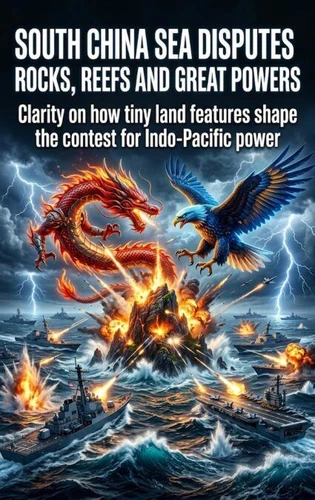
South China Sea Disputes: Rocks, Reefs and Great Powers. Clarity on how tiny land features shape the contest for Indo‑Pacific power
Par :Formats :
Disponible dans votre compte client Decitre ou Furet du Nord dès validation de votre commande. Le format ePub est :
- Compatible avec une lecture sur My Vivlio (smartphone, tablette, ordinateur)
- Compatible avec une lecture sur liseuses Vivlio
- Pour les liseuses autres que Vivlio, vous devez utiliser le logiciel Adobe Digital Edition. Non compatible avec la lecture sur les liseuses Kindle, Remarkable et Sony
 , qui est-ce ?
Notre partenaire de plateforme de lecture numérique où vous retrouverez l'ensemble de vos ebooks gratuitement
Pour en savoir plus sur nos ebooks, consultez notre aide en ligne ici
C'est si simple ! Lisez votre ebook avec l'app Vivlio sur votre tablette, mobile ou ordinateur :

- Nombre de pages212
- FormatePub
- ISBN978-3-565-37115-0
- EAN9783565371150
- Date de parution30/03/2026
- Protection num.pas de protection
- Taille2 Mo
- Infos supplémentairesepub
- ÉditeurEmphaloz Publishing House
Résumé
The South China Sea is less a monolithic "ocean" than a mosaic of rocks, reefs, shoals, and atolls that have become prizes in a contest between great powers and neighboring states. This book traces the evolution of the disputes from early navigation routes and colonial maps to the modern "nine-dash line, " the 2016 arbitration ruling, and the construction of airstrips and guard posts on reclaimed features.
It explains how each contested outcrop-such as the Paracel and Spratly Islands and Scarborough Shoal-carries outsized legal, military, and symbolic weight, turning handfuls of stone and sand into anchors of air-defence zones and potential flashpoints. Drawing on history, maritime-law analysis, and documentary-style field reporting, it shows how China, the United States, Vietnam, the Philippines, Malaysia, Brunei, and Taiwan use surveillance flights, coast-guard patrols, and archaeological surveys to assert presence and memory.
The narrative also situates the South China Sea within the broader Indo-Pacific and Taiwan Strait context, highlighting how these disputes weave into alliance systems, freedom-of-navigation operations, and regional imaginations of sovereignty. The aim is not to pick a side, but to make the rocky, reef-strewn geometry of power in the region intelligible.
It explains how each contested outcrop-such as the Paracel and Spratly Islands and Scarborough Shoal-carries outsized legal, military, and symbolic weight, turning handfuls of stone and sand into anchors of air-defence zones and potential flashpoints. Drawing on history, maritime-law analysis, and documentary-style field reporting, it shows how China, the United States, Vietnam, the Philippines, Malaysia, Brunei, and Taiwan use surveillance flights, coast-guard patrols, and archaeological surveys to assert presence and memory.
The narrative also situates the South China Sea within the broader Indo-Pacific and Taiwan Strait context, highlighting how these disputes weave into alliance systems, freedom-of-navigation operations, and regional imaginations of sovereignty. The aim is not to pick a side, but to make the rocky, reef-strewn geometry of power in the region intelligible.