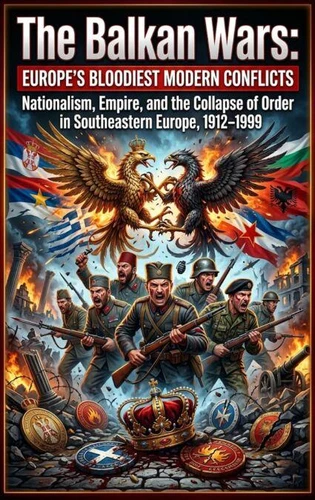
The Balkan Wars: Europe's Bloodiest Modern Conflicts. Nationalism, Empire, and the Collapse of Order in Southeastern Europe, 1912–1999
Par :Formats :
Disponible dans votre compte client Decitre ou Furet du Nord dès validation de votre commande. Le format ePub est :
- Compatible avec une lecture sur My Vivlio (smartphone, tablette, ordinateur)
- Compatible avec une lecture sur liseuses Vivlio
- Pour les liseuses autres que Vivlio, vous devez utiliser le logiciel Adobe Digital Edition. Non compatible avec la lecture sur les liseuses Kindle, Remarkable et Sony
 , qui est-ce ?
Notre partenaire de plateforme de lecture numérique où vous retrouverez l'ensemble de vos ebooks gratuitement
Pour en savoir plus sur nos ebooks, consultez notre aide en ligne ici
C'est si simple ! Lisez votre ebook avec l'app Vivlio sur votre tablette, mobile ou ordinateur :

- Nombre de pages238
- FormatePub
- ISBN978-3-565-32684-6
- EAN9783565326846
- Date de parution15/03/2026
- Protection num.pas de protection
- Taille2 Mo
- Infos supplémentairesepub
- ÉditeurEmphaloz Publishing House
Résumé
The Balkans have been called the "powder keg of Europe"-a region where empires collided, nations were born, and old grievances never fully died. From the Balkan Wars of 1912-1913, which shattered Ottoman rule, to the brutal Yugoslav conflicts of the 1990s, this book traces nearly a century of violence that reshaped Europe's political and moral landscape.
Drawing on diplomatic archives, military reports, and eyewitness testimonies, it examines how nationalism, revenge, and foreign intervention repeatedly ignited wars that blurred the lines between liberation and atrocity.
The narrative follows the breakdown of imperial borders, the birth of new states, and the cycles of ethnic cleansing and occupation that followed-revealing how fragile coexistence became the exception rather than the rule. This is not only a chronicle of warfare, but a study of identity, memory, and the enduring scars of fragmentation. The Balkan experience exposes the volatility at the heart of modern Europe: the struggle to balance collective belonging with human rights, power with justice, and memory with reconciliation.
The narrative follows the breakdown of imperial borders, the birth of new states, and the cycles of ethnic cleansing and occupation that followed-revealing how fragile coexistence became the exception rather than the rule. This is not only a chronicle of warfare, but a study of identity, memory, and the enduring scars of fragmentation. The Balkan experience exposes the volatility at the heart of modern Europe: the struggle to balance collective belonging with human rights, power with justice, and memory with reconciliation.