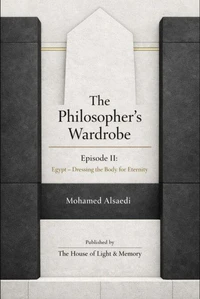
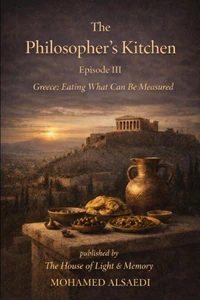
What does it mean for the body to end-not biologically, but philosophically? In this final episode of The Philosopher's Wardrobe, Mohamed Alsaedi examines Ancient Greece not as the origin of Western corporeality, but as the point at which a specific logic of the body reaches conceptual completion. Against traditions that preserve, archive, or extend the body in order to save meaning, Greek thought binds meaning to visibility, measure, and finite appearance-and allows the body to end without remainder. This book does not offer a historical survey of Greek culture, nor does it seek to recover Greek ideals for contemporary use.
Instead, it reconstructs a disciplined philosophical economy in which the body owes nothing beyond its appearance, memory is unnecessary for intelligibility, and continuation becomes distortion rather than fulfillment. Through a rigorous analysis of form, proportion, exposure, and limit, Alsaedi argues that Greece does not bridge the body toward eternity. It defines the conditions under which further extension loses philosophical necessity.
The body leaves philosophy intact-and philosophy learns the discipline of stopping. Greece: The Body as Measure, Not Memory concludes a three-episode series by clarifying not what the body becomes after Greece, but why, within the Greek horizon, nothing essential remains deferred.
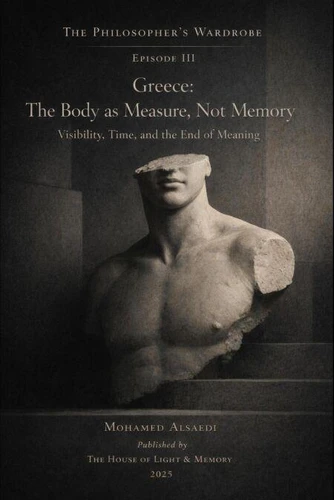
What does it mean for the body to end-not biologically, but philosophically? In this final episode of The Philosopher's Wardrobe, Mohamed Alsaedi examines Ancient Greece not as the origin of Western corporeality, but as the point at which a specific logic of the body reaches conceptual completion. Against traditions that preserve, archive, or extend the body in order to save meaning, Greek thought binds meaning to visibility, measure, and finite appearance-and allows the body to end without remainder. This book does not offer a historical survey of Greek culture, nor does it seek to recover Greek ideals for contemporary use.
Instead, it reconstructs a disciplined philosophical economy in which the body owes nothing beyond its appearance, memory is unnecessary for intelligibility, and continuation becomes distortion rather than fulfillment. Through a rigorous analysis of form, proportion, exposure, and limit, Alsaedi argues that Greece does not bridge the body toward eternity. It defines the conditions under which further extension loses philosophical necessity.
The body leaves philosophy intact-and philosophy learns the discipline of stopping. Greece: The Body as Measure, Not Memory concludes a three-episode series by clarifying not what the body becomes after Greece, but why, within the Greek horizon, nothing essential remains deferred.


 , qui est-ce ?