What does it mean to eat in a civilization that refuses to end? In this second episode of The Philosopher's Kitchen, Egypt appears not as a historical subject, but as a living logic-one that understands food as a discipline against disappearance. This book is not a history of Egyptian cuisine, nor a collection of recipes. It is a philosophical inquiry into how a civilization thought with food: how bread, salt, preservation, and repetition became tools for stabilizing time itself. Moving between ancient practices and contemporary echoes, the text explores kitchens as architectural systems, meals as rituals of continuity, and nourishment as participation in an order designed to outlast individual lives.
Bread is not comfort here. Salt is not seasoning. Preservation is not technique. Each becomes a language through which Egypt negotiated endurance. Written in a quiet, reflective voice, this episode treats everyday acts-kneading dough, storing grain, setting a table-as serious forms of thought. Food is revealed not as indulgence or survival alone, but as a refusal to let the world dissolve into chaos. The Philosopher's Kitchen - Episode II: Egypt invites the reader to slow down, observe repetition, and reconsider what it means to prepare for a future that is expected to continue.
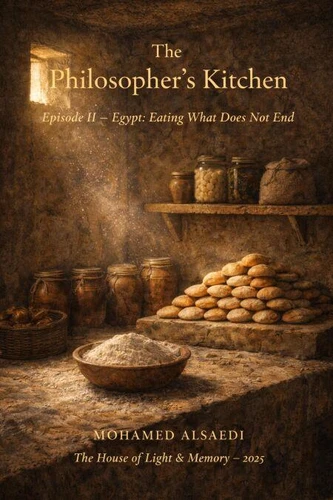
What does it mean to eat in a civilization that refuses to end? In this second episode of The Philosopher's Kitchen, Egypt appears not as a historical subject, but as a living logic-one that understands food as a discipline against disappearance. This book is not a history of Egyptian cuisine, nor a collection of recipes. It is a philosophical inquiry into how a civilization thought with food: how bread, salt, preservation, and repetition became tools for stabilizing time itself. Moving between ancient practices and contemporary echoes, the text explores kitchens as architectural systems, meals as rituals of continuity, and nourishment as participation in an order designed to outlast individual lives.
Bread is not comfort here. Salt is not seasoning. Preservation is not technique. Each becomes a language through which Egypt negotiated endurance. Written in a quiet, reflective voice, this episode treats everyday acts-kneading dough, storing grain, setting a table-as serious forms of thought. Food is revealed not as indulgence or survival alone, but as a refusal to let the world dissolve into chaos. The Philosopher's Kitchen - Episode II: Egypt invites the reader to slow down, observe repetition, and reconsider what it means to prepare for a future that is expected to continue.


 , qui est-ce ?