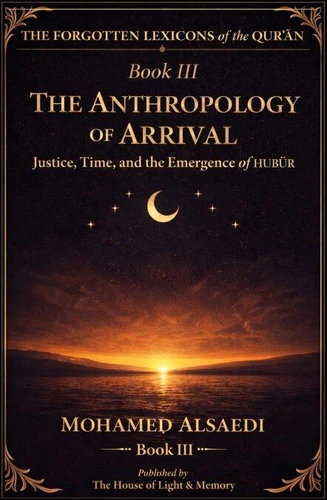
The Anthropology of Arrival: Justice, Time, and the Emergence of ?ubur is the third and final volume in The Forgotten Lexicons of the Qur'an, a philosophical and anthropological inquiry into ethical concepts whose depth has faded from modern understanding. This volume moves beyond defining jubilation (?ubur) or establishing its moral conditions. Instead, it asks a more radical question: What kind of human being emerges once justice has been fulfilled? Drawing on Qur'anic language, moral anthropology, and structural analysis, the book argues that justice is not the end of ethical life, but the threshold that makes arrival possible.
When injustice persists, memory remains wounded, time collapses into waiting, and identity hardens into defense. When justice is fulfilled, these structures are released. Memory becomes testimony rather than accusation. Time regains sufficiency rather than urgency. Identity loosens its armor and becomes available to life. Jubilation, in this framework, is not an emotion to be cultivated or a mood to be managed.
It is the ontological resonance of a life no longer organized around survival. It appears not as happiness, but as ease-an ethical lightness that emerges only after truth has been clarified, fear has withdrawn, and responsibility has been discharged. By situating psychology, therapy, and modern healing systems within a larger moral architecture, this book does not reject contemporary approaches to suffering.
It governs them-naming when they are necessary, and when their continued application becomes distortion. The Anthropology of Arrival offers a Qur'anic account of what modern thought rarely imagines: not endless coping, not perpetual repair, but rest after justice-where meaning no longer strains to hold itself together, and joy appears not as aspiration, but as evidence.
The Anthropology of Arrival: Justice, Time, and the Emergence of ?ubur is the third and final volume in The Forgotten Lexicons of the Qur'an, a philosophical and anthropological inquiry into ethical concepts whose depth has faded from modern understanding. This volume moves beyond defining jubilation (?ubur) or establishing its moral conditions. Instead, it asks a more radical question: What kind of human being emerges once justice has been fulfilled? Drawing on Qur'anic language, moral anthropology, and structural analysis, the book argues that justice is not the end of ethical life, but the threshold that makes arrival possible.
When injustice persists, memory remains wounded, time collapses into waiting, and identity hardens into defense. When justice is fulfilled, these structures are released. Memory becomes testimony rather than accusation. Time regains sufficiency rather than urgency. Identity loosens its armor and becomes available to life. Jubilation, in this framework, is not an emotion to be cultivated or a mood to be managed.
It is the ontological resonance of a life no longer organized around survival. It appears not as happiness, but as ease-an ethical lightness that emerges only after truth has been clarified, fear has withdrawn, and responsibility has been discharged. By situating psychology, therapy, and modern healing systems within a larger moral architecture, this book does not reject contemporary approaches to suffering.
It governs them-naming when they are necessary, and when their continued application becomes distortion. The Anthropology of Arrival offers a Qur'anic account of what modern thought rarely imagines: not endless coping, not perpetual repair, but rest after justice-where meaning no longer strains to hold itself together, and joy appears not as aspiration, but as evidence.


 , qui est-ce ?