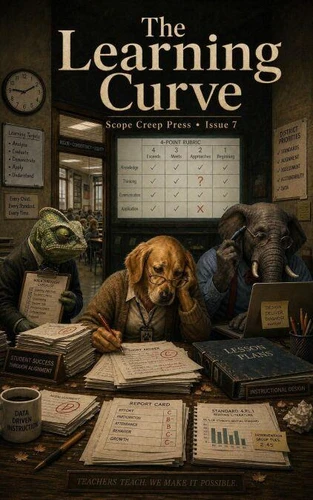
The children are still in the room. That's the thing nobody on the administrative side seems to remember. The Learning Curve is the seventh issue of Scope Creep Press, an unconventional fiction magazine in book form. Three longer stories and three shorter pieces about teachers and EdTech under pressure at Riverside School District, where educational technology promises liberation but delivers standardized compliance.
A golden retriever teacher fights to keep his class a class instead of a storage solution through a roster drop, missing furniture, a missing IEP aide, a hallway desk that becomes a humiliation, a district ping, and a leaked metric note. A chameleon edtech consultant edits an investor deck while support logs show students timing out and teachers reverting to paper-each slide revision removing a classroom fact.
She hands over the polished deck but keeps the uncut export. An elephant instructional designer remembers a reading intervention that worked, watches the new platform fail live, and builds an unofficial 'extra credit' workaround teachers can use without waiting for permission. The shorter pieces are where the dread lives. A border collie inherits overflow detention and discovers it's where the school parks children with unsolved needs-charger fight, nurse trip, missing counselor, stale snack box, and one student who only speaks when she stops treating the room as discipline.
A rabbit IT coordinator thinks he's fixing a frozen quiz app; the student keeps clicking the same answer because the app is the only safe way to signal confusion. A cat administrator finds a perfect student record with no student attached: immaculate assignments, no intake packet, no family contact, login times that match another child's work. District data leaks appear in Assessment Protocol audits.
The software vendor is Greg Anders' company from Ticket Closed. Lauren's firm shares clients with TechFlow from Workflow Anomalies. Created through a combination of human writing and generative AI, used for internal consistency across an interconnected multi-issue series.
The children are still in the room. That's the thing nobody on the administrative side seems to remember. The Learning Curve is the seventh issue of Scope Creep Press, an unconventional fiction magazine in book form. Three longer stories and three shorter pieces about teachers and EdTech under pressure at Riverside School District, where educational technology promises liberation but delivers standardized compliance.
A golden retriever teacher fights to keep his class a class instead of a storage solution through a roster drop, missing furniture, a missing IEP aide, a hallway desk that becomes a humiliation, a district ping, and a leaked metric note. A chameleon edtech consultant edits an investor deck while support logs show students timing out and teachers reverting to paper-each slide revision removing a classroom fact.
She hands over the polished deck but keeps the uncut export. An elephant instructional designer remembers a reading intervention that worked, watches the new platform fail live, and builds an unofficial 'extra credit' workaround teachers can use without waiting for permission. The shorter pieces are where the dread lives. A border collie inherits overflow detention and discovers it's where the school parks children with unsolved needs-charger fight, nurse trip, missing counselor, stale snack box, and one student who only speaks when she stops treating the room as discipline.
A rabbit IT coordinator thinks he's fixing a frozen quiz app; the student keeps clicking the same answer because the app is the only safe way to signal confusion. A cat administrator finds a perfect student record with no student attached: immaculate assignments, no intake packet, no family contact, login times that match another child's work. District data leaks appear in Assessment Protocol audits.
The software vendor is Greg Anders' company from Ticket Closed. Lauren's firm shares clients with TechFlow from Workflow Anomalies. Created through a combination of human writing and generative AI, used for internal consistency across an interconnected multi-issue series.

 , qui est-ce ?