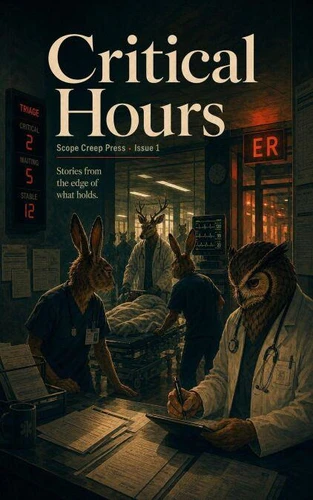
The board says the ER is running efficiently. The hallway says otherwise. Critical Hours is the first issue of Scope Creep Press, an unconventional fiction magazine in book form. Three longer stories and four shorter pieces about nursing and allied healthcare at St. Vincent's Medical Center, where the hallway is more trustworthy than the glowing board overhead. A rabbit charge nurse watches a new AI patient-load system optimize for metrics instead of care-his veteran instincts reclassified as inefficiencies.
A deer social work nurse faces mounting pressure to clear beds faster, discovering that discharge options loop back to homelessness in bureaucratic recursion. A hare float pool nurse uncovers systematic bias where predatory doctors assign riskier cases to prey species nurses. The shorter pieces bite fast: a mouse nurse investigates why a badger Holocaust survivor becomes agitated by the hospital's automated wellness playlist.
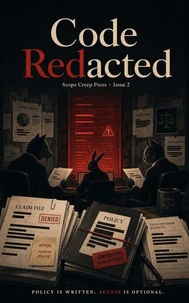
Two mice compete obsessively over documentation metrics during an understaffed shift. A rabbit nurse uses warren-navigation skills to trace missing equipment through the shadow networks that keep the hospital functioning despite official system failures. A fox patient from St. Vincent's shows up as a denied claim in Code Redacted. The bed pressure created by the AI optimization surfaces downstream.
The connections are there for readers who want them. Not cozy, not sexy, just operational. Created through a combination of human writing and generative AI, used for internal consistency across an interconnected multi-issue series.
The board says the ER is running efficiently. The hallway says otherwise. Critical Hours is the first issue of Scope Creep Press, an unconventional fiction magazine in book form. Three longer stories and four shorter pieces about nursing and allied healthcare at St. Vincent's Medical Center, where the hallway is more trustworthy than the glowing board overhead. A rabbit charge nurse watches a new AI patient-load system optimize for metrics instead of care-his veteran instincts reclassified as inefficiencies.
A deer social work nurse faces mounting pressure to clear beds faster, discovering that discharge options loop back to homelessness in bureaucratic recursion. A hare float pool nurse uncovers systematic bias where predatory doctors assign riskier cases to prey species nurses. The shorter pieces bite fast: a mouse nurse investigates why a badger Holocaust survivor becomes agitated by the hospital's automated wellness playlist.
Two mice compete obsessively over documentation metrics during an understaffed shift. A rabbit nurse uses warren-navigation skills to trace missing equipment through the shadow networks that keep the hospital functioning despite official system failures. A fox patient from St. Vincent's shows up as a denied claim in Code Redacted. The bed pressure created by the AI optimization surfaces downstream.
The connections are there for readers who want them. Not cozy, not sexy, just operational. Created through a combination of human writing and generative AI, used for internal consistency across an interconnected multi-issue series.

 , qui est-ce ?