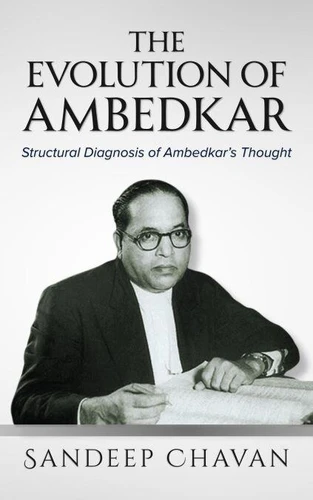
The Evolution of Ambedkar: Structural Diagnosis of Ambedkar's Thought by Sandeep J. Chavan, is a serious, reflective, and non-biographical study of Dr. B. R. Ambedkar's intellectual journey. This book does not attempt to write another conventional biography of Ambedkar. It does not worship, attack, defend, or reduce him to a political symbol, slogan, or fixed image. Instead, it studies Ambedkar as a moving mind shaped by historical pressure, caste humiliation, education, scholarship, social resistance, constitutional responsibility, and unresolved democratic questions.
Dr. B. R. Ambedkar is often remembered as the architect of the Indian Constitution, a fierce critic of caste, a leader of the oppressed, a scholar, a social reformer, and a Buddhist convert. Each of these identities carries truth, but none alone is complete. This book asks a deeper question: how did Ambedkar's thought evolve as he moved through a broken social field?Using a structural diagnostic lens, the book examines Ambedkar's journey through observation, resistance, rebellion, reform, constitutional architecture, later moral search, and productive friction.
It studies the India he was observing-caste-fractured, unequal, religiously layered, politically unstable, and socially wounded-and asks how a highly analytical mind responded to such a reality. The book explores major themes such as caste, social democracy, constitutional morality, representation, minority safeguards, political democracy, religious conversion, Buddhism, dignity, equality, fraternity, and the gap between constitutional ideals and lived social behavior.
It also asks whether Ambedkar fully saw the gap between intellectual design and India's physical reality, whether his academic and constitutional lens was a strength, a burden, or both, and whether he reached silent resolution or became a necessary unresolved signal for future India. Rather than forcing a verdict, The Evolution of Ambedkar keeps certain questions deliberately open. It argues that Ambedkar's continuing relevance may lie not only in what he completed, but in what he made impossible for India to ignore: caste without dignity, democracy without social equality, law without lived justice, and constitutionalism without moral discipline.
This book is intended for readers interested in Ambedkar studies, Indian democracy, caste and society, social justice, constitutional thought, political philosophy, Buddhism, Dalit thought, and the deeper evolution of modern India's unresolved questions. It is a book for readers who want to go beyond statue, slogan, and political ownership-and study Ambedkar as a mind still moving through history.
The Evolution of Ambedkar: Structural Diagnosis of Ambedkar's Thought by Sandeep J. Chavan, is a serious, reflective, and non-biographical study of Dr. B. R. Ambedkar's intellectual journey. This book does not attempt to write another conventional biography of Ambedkar. It does not worship, attack, defend, or reduce him to a political symbol, slogan, or fixed image. Instead, it studies Ambedkar as a moving mind shaped by historical pressure, caste humiliation, education, scholarship, social resistance, constitutional responsibility, and unresolved democratic questions.
Dr. B. R. Ambedkar is often remembered as the architect of the Indian Constitution, a fierce critic of caste, a leader of the oppressed, a scholar, a social reformer, and a Buddhist convert. Each of these identities carries truth, but none alone is complete. This book asks a deeper question: how did Ambedkar's thought evolve as he moved through a broken social field?Using a structural diagnostic lens, the book examines Ambedkar's journey through observation, resistance, rebellion, reform, constitutional architecture, later moral search, and productive friction.
It studies the India he was observing-caste-fractured, unequal, religiously layered, politically unstable, and socially wounded-and asks how a highly analytical mind responded to such a reality. The book explores major themes such as caste, social democracy, constitutional morality, representation, minority safeguards, political democracy, religious conversion, Buddhism, dignity, equality, fraternity, and the gap between constitutional ideals and lived social behavior.
It also asks whether Ambedkar fully saw the gap between intellectual design and India's physical reality, whether his academic and constitutional lens was a strength, a burden, or both, and whether he reached silent resolution or became a necessary unresolved signal for future India. Rather than forcing a verdict, The Evolution of Ambedkar keeps certain questions deliberately open. It argues that Ambedkar's continuing relevance may lie not only in what he completed, but in what he made impossible for India to ignore: caste without dignity, democracy without social equality, law without lived justice, and constitutionalism without moral discipline.
This book is intended for readers interested in Ambedkar studies, Indian democracy, caste and society, social justice, constitutional thought, political philosophy, Buddhism, Dalit thought, and the deeper evolution of modern India's unresolved questions. It is a book for readers who want to go beyond statue, slogan, and political ownership-and study Ambedkar as a mind still moving through history.


 , qui est-ce ?