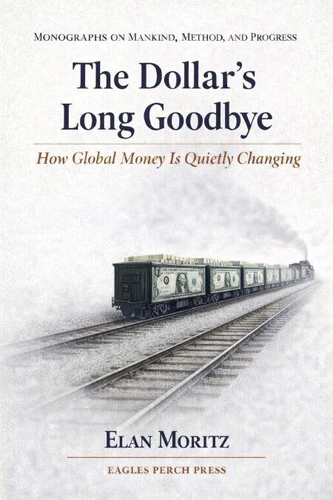
The Dollar's Long Goodbye: How Global Money Is Quietly Changing. Monographs on Mankind, Method, and Progress, #1
Par :Formats :
Disponible dans votre compte client Decitre ou Furet du Nord dès validation de votre commande. Le format ePub protégé est :
- Compatible avec une lecture sur My Vivlio (smartphone, tablette, ordinateur)
- Compatible avec une lecture sur liseuses Vivlio
- Pour les liseuses autres que Vivlio, vous devez utiliser le logiciel Adobe Digital Edition. Non compatible avec la lecture sur les liseuses Kindle, Remarkable et Sony
- Non compatible avec un achat hors France métropolitaine
 , qui est-ce ?
Notre partenaire de plateforme de lecture numérique où vous retrouverez l'ensemble de vos ebooks gratuitement
Pour en savoir plus sur nos ebooks, consultez notre aide en ligne ici
C'est si simple ! Lisez votre ebook avec l'app Vivlio sur votre tablette, mobile ou ordinateur :

- FormatePub
- ISBN978-1-971491-05-9
- EAN9781971491059
- Date de parution03/02/2026
- Protection num.Adobe DRM
- Infos supplémentairesepub
- ÉditeurEagles Perch Press
Résumé
Something is shifting in global finance. Central banks are buying gold at the fastest pace in decades. China and Russia settle energy trades in renminbi. BRICS nations discuss alternative payment systems. COFER, CIPS, mBridge, PAPSS appear in financial news. What does it all mean?The Dollar's Long Goodbye cuts through the noise. Find out what's actually happening to the world's dominant currency-and why it matters.
The core insight is simple but important: de-dollarization isn't a sudden event. It's a gradual thinning at the margins. The dollar remains dominant, but it's becoming less unavoidable. More corridors exist for trade settlement. More options exist for reserve storage. More alternatives exist for those who want-or need-them. Think of global money as plumbing, not a throne. A throne is either occupied or vacant.
This book explains how the dollar system actually works-the petrodollar mechanism, correspondent banking, SWIFT messaging, Treasury collateral, Fed swap lines-and where the pressure points are. It examines what the euro can and cannot replace, why China's renminbi faces structural ceilings, and what regional arrangements from ASEAN to Africa actually accomplish. No jargon. No equations. No hundreds of footnotes.
Just clear explanation of the mechanics, the evidence, and the uncertainties. The Dollar's Long Goodbye gives general readers the understanding they need to follow one of the most consequential economic stories of our time. The dollar's long goodbye has begun. This book helps you see it clearly. For investors, corporate treasurers, and financial professionals, the de-dollarization debate presents a practical challenge: separating signal from noise.
Headlines oscillate between "dollar collapse imminent" and "nothing to see here." Neither extreme serves decision-making. The Dollar's Long Goodbye also provides the analytical framework professionals need. Based on the comprehensive technical edition De-Dollarization and Financial Statecraft, the book distills institutional research into actionable understanding without requiring specialized background in international monetary economics.
We discuss: Reserve and portfolio implications: Understanding how central bank behavior is shifting- gold accumulation, currency diversification, custody geography changes-and what it signals about institutional assessment of sovereignty risk. Payments and settlement: How alternative rails (CIPS, mBridge, regional systems) aredeveloping, where they're gaining traction, and what corridor-specific changes mean for transaction costs and counterparty relationships.
Sanctions and compliance: How the 2022 reserve freeze changed institutional calculus, why "behavior changes first, narratives later, " and what the emergence of "permissioned" versus "non-permissioned" asset categories means for risk assessment. Scenario planning: Four distinct scenario families-baseline continuation, two-system competition, fragmented blocs, and collateral shifts-with measurable signatures and failure modes for each.
Basis and hedging: Why liquidity segmentation and persistent parity deviations may become structural features rather than temporary dislocations, and what that means for hedging costs. The book includes a glossary of 70+ key terms and curated guidance to primary data sources (IMF COFER, BIS statistics, World Gold Council) for ongoing monitoring. This essential guide is recommended for knowledgable citizens & professionals who need to understand global monetary evolution without reading a 500-page academic treatise.
The core insight is simple but important: de-dollarization isn't a sudden event. It's a gradual thinning at the margins. The dollar remains dominant, but it's becoming less unavoidable. More corridors exist for trade settlement. More options exist for reserve storage. More alternatives exist for those who want-or need-them. Think of global money as plumbing, not a throne. A throne is either occupied or vacant.
This book explains how the dollar system actually works-the petrodollar mechanism, correspondent banking, SWIFT messaging, Treasury collateral, Fed swap lines-and where the pressure points are. It examines what the euro can and cannot replace, why China's renminbi faces structural ceilings, and what regional arrangements from ASEAN to Africa actually accomplish. No jargon. No equations. No hundreds of footnotes.
Just clear explanation of the mechanics, the evidence, and the uncertainties. The Dollar's Long Goodbye gives general readers the understanding they need to follow one of the most consequential economic stories of our time. The dollar's long goodbye has begun. This book helps you see it clearly. For investors, corporate treasurers, and financial professionals, the de-dollarization debate presents a practical challenge: separating signal from noise.
Headlines oscillate between "dollar collapse imminent" and "nothing to see here." Neither extreme serves decision-making. The Dollar's Long Goodbye also provides the analytical framework professionals need. Based on the comprehensive technical edition De-Dollarization and Financial Statecraft, the book distills institutional research into actionable understanding without requiring specialized background in international monetary economics.
We discuss: Reserve and portfolio implications: Understanding how central bank behavior is shifting- gold accumulation, currency diversification, custody geography changes-and what it signals about institutional assessment of sovereignty risk. Payments and settlement: How alternative rails (CIPS, mBridge, regional systems) aredeveloping, where they're gaining traction, and what corridor-specific changes mean for transaction costs and counterparty relationships.
Sanctions and compliance: How the 2022 reserve freeze changed institutional calculus, why "behavior changes first, narratives later, " and what the emergence of "permissioned" versus "non-permissioned" asset categories means for risk assessment. Scenario planning: Four distinct scenario families-baseline continuation, two-system competition, fragmented blocs, and collateral shifts-with measurable signatures and failure modes for each.
Basis and hedging: Why liquidity segmentation and persistent parity deviations may become structural features rather than temporary dislocations, and what that means for hedging costs. The book includes a glossary of 70+ key terms and curated guidance to primary data sources (IMF COFER, BIS statistics, World Gold Council) for ongoing monitoring. This essential guide is recommended for knowledgable citizens & professionals who need to understand global monetary evolution without reading a 500-page academic treatise.
A propos de Elan Moritz




3,99 €