Dernière sortie
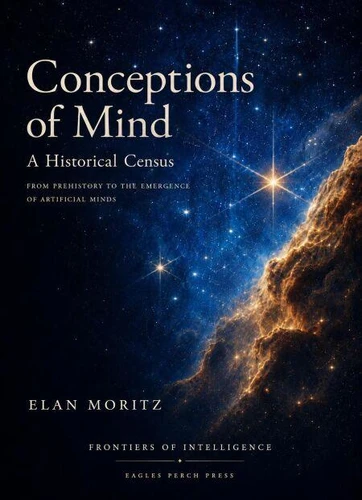
Conceptions of Mind: From Prehistory to the Emergence of Artificial Minds
This book is about getting ready for Artificial Minds. When you think Ai and LLMs are the pinnacle, it turns out they're not. The real paradigm shift and challenges will come when we have to face and work with artificial minds. This is book is about equipping ourselves with the tools to understand, discuss, and prepare for Artificial and Digital Minds. Conceptions of Mind: A Historical Census takes a census of one of the oldest and most consequential ideas in human thought: the idea of mind itself.
Across nearly three thousand years, from the breath-souls of the Homeric poems to the language models and autonomous agents of the presentday, human beings have proposed a remarkable variety of answers to a deceptively simple question: what is a mind? This book gathers those answers, sets them side by side on common ground, and reads them as a single, cumulative inquiry that arrives, at last, at the machines we are now building.
The book's method is genealogical and its structure is a survey. Each major conception of mind is entered in turn: Homeric, Presocratic, Pythagorean, Platonic, Aristotelian, Stoic, Augustinian, Cartesian, Lockean, Humean, Kantian, and onward through the phenomenologists, the behaviorists, the functionalists, the contemporary sciences of consciousness, and the enactivist tradition that disputes them.
Each is read for what it contributes to a growing understanding rather than merely catalogued as a historical curiosity. The result is not an encyclopedia but an argument: a demonstration that the long history of thinking about mind has a shape, and that seeing the shape is what allows us to think clearly about the newest minds of all. At the center of the book is a single analytic instrument, developed as the survey proceeds and sharpened against each conception it meets.
The instrument begins by separating two questions that the history of the subject has persistently run together. The question of what a mind is, and the question of what a mind is made of is tested for each thinker and theory offered. The approach shows how much clarity is gained simply by keeping them apart. It then distinguishes the properties that the single word "mind" has always bundled: the capacity to achieve goals, the capacity to act in the world, and, at the core, the two marks that carry the philosophical and moral weight-phenomenal experience, the fact that there is somethingit is like to be a given system, and original intentionality, the genuine directedness of a mind'sstates toward the world.
The book is generous to the positions it does not adopt. It gives the contemporary science of consciousness-global workspace theory, integrated information theory, higher-order and attention-schema theories, and the predictive-processing framework-a substantial hearing, and it devotes a full and sympathetic treatment to enactivism, the tradition that holds mind to be inseparable from living embodiment and that stands as the most serious living challenge to the book's own organizing picture.
Throughout, the aim is to present each conception at its strongest, so that the reader encounters the full space of live possibilities and is equipped to navigate it independently. Rigorous in its scholarship written for philosophers and cognitive scientists, for researchers and students of artificial intelligence, and for any reader who wants to understand the concept on which every question about thinking machines ultimately rests.
The book is a founding volume in Eagles Perch Press's Frontiers of Intelligence series dealing with Artificial and Digital Minds.and it aims to lay the ground on which the series' further inquiries can stand. The scope of the book? From Prehistory to the Emergence of Artificial Minds.
Across nearly three thousand years, from the breath-souls of the Homeric poems to the language models and autonomous agents of the presentday, human beings have proposed a remarkable variety of answers to a deceptively simple question: what is a mind? This book gathers those answers, sets them side by side on common ground, and reads them as a single, cumulative inquiry that arrives, at last, at the machines we are now building.
The book's method is genealogical and its structure is a survey. Each major conception of mind is entered in turn: Homeric, Presocratic, Pythagorean, Platonic, Aristotelian, Stoic, Augustinian, Cartesian, Lockean, Humean, Kantian, and onward through the phenomenologists, the behaviorists, the functionalists, the contemporary sciences of consciousness, and the enactivist tradition that disputes them.
Each is read for what it contributes to a growing understanding rather than merely catalogued as a historical curiosity. The result is not an encyclopedia but an argument: a demonstration that the long history of thinking about mind has a shape, and that seeing the shape is what allows us to think clearly about the newest minds of all. At the center of the book is a single analytic instrument, developed as the survey proceeds and sharpened against each conception it meets.
The instrument begins by separating two questions that the history of the subject has persistently run together. The question of what a mind is, and the question of what a mind is made of is tested for each thinker and theory offered. The approach shows how much clarity is gained simply by keeping them apart. It then distinguishes the properties that the single word "mind" has always bundled: the capacity to achieve goals, the capacity to act in the world, and, at the core, the two marks that carry the philosophical and moral weight-phenomenal experience, the fact that there is somethingit is like to be a given system, and original intentionality, the genuine directedness of a mind'sstates toward the world.
The book is generous to the positions it does not adopt. It gives the contemporary science of consciousness-global workspace theory, integrated information theory, higher-order and attention-schema theories, and the predictive-processing framework-a substantial hearing, and it devotes a full and sympathetic treatment to enactivism, the tradition that holds mind to be inseparable from living embodiment and that stands as the most serious living challenge to the book's own organizing picture.
Throughout, the aim is to present each conception at its strongest, so that the reader encounters the full space of live possibilities and is equipped to navigate it independently. Rigorous in its scholarship written for philosophers and cognitive scientists, for researchers and students of artificial intelligence, and for any reader who wants to understand the concept on which every question about thinking machines ultimately rests.
The book is a founding volume in Eagles Perch Press's Frontiers of Intelligence series dealing with Artificial and Digital Minds.and it aims to lay the ground on which the series' further inquiries can stand. The scope of the book? From Prehistory to the Emergence of Artificial Minds.
Les livres de Elan Moritz




3,99 €