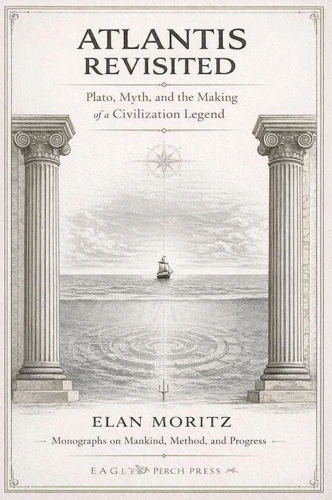
Atlantis Revisited. Monographs on Mankind, Method, and Progress, #5
Par :Formats :
Disponible dans votre compte client Decitre ou Furet du Nord dès validation de votre commande. Le format ePub protégé est :
- Compatible avec une lecture sur My Vivlio (smartphone, tablette, ordinateur)
- Compatible avec une lecture sur liseuses Vivlio
- Pour les liseuses autres que Vivlio, vous devez utiliser le logiciel Adobe Digital Edition. Non compatible avec la lecture sur les liseuses Kindle, Remarkable et Sony
- Non compatible avec un achat hors France métropolitaine
 , qui est-ce ?
Notre partenaire de plateforme de lecture numérique où vous retrouverez l'ensemble de vos ebooks gratuitement
Pour en savoir plus sur nos ebooks, consultez notre aide en ligne ici
C'est si simple ! Lisez votre ebook avec l'app Vivlio sur votre tablette, mobile ou ordinateur :

- FormatePub
- ISBN978-1-971491-09-7
- EAN9781971491097
- Date de parution20/03/2026
- Protection num.Adobe DRM
- Infos supplémentairesepub
- ÉditeurEagles Perch Press
Résumé
Why has Atlantis endured with such unusual force for more than two millennia?Most books on Atlantis take one of two paths. They either pursue the lost city as if it were a hidden geographical secret waiting to be recovered, or they dismiss it as a famous but exhausted fable. Atlantis Revisited takes a different path. It argues that Atlantis is best understood not as a single historical proposition but as one of the most durable civilizational legends in the Western archive.
The book begins where it must: with Plato's Timaeus and Critias, where Atlantis first appears as a philosophically staged pseudo-history-morally charged, politically comparative, historically suggestive, and deliberately unfinished. From there, the argument follows the long afterlife of Atlantis across later antiquity, Renaissance humanism, utopian writing, and, above all, Francis Bacon's New Atlantis, where the Atlantean frame is redirected toward organized inquiry, institutional design, and the future of knowledge.
The study then turns to the nineteenth century, when Ignatius Donnelly transformed Atlantis into a totalizing origin-story for civilization, and to the darker modern afterlives in which Atlantis became entangled with racial myth, nationalism, pseudoarchaeology, and the displacement of indigenous achievement. These chapters show that Atlantis is not an innocent cultural curiosity. It has repeatedly functioned as a site of ideological projection and explanatory excess.
Yet Atlantis also continued to evolve in more expansive and revealing ways. Modern iterature, comics, cinema, television, games, music, and digital culture turned Atlantis into a portable world-frame: spectacular, serial, participatory, and endlessly reusable. The book therefore treats Atlantis not only as a classical inheritance but as a modern media object, a civilizational mirror, and a myth of recoverable loss.
It asks why Atlantis persists, why it scales so well across media, and why advanced societies repeatedly return to stories of hidden greatness and catastrophic disappearance. The final synthesis argues that Atlantis did not merely survive; it was progressively made into a civilization-legend by successive reinterpretive regimes. Plato created the foundational form. Bacon turned it toward institutional futurity.
Donnelly literalized it. Nationalism and pseudoarchaeology weaponized it. Modern media scaled it. The climate era has begun to reactivate it once more as a warning about civilizational fragility. Written for scholars, serious general readers, and anyone interested in the history of ideas, myth, political thought, pseudoarchaeology, and media culture, Atlantis Revisited offers a comprehensive and deeply interdisciplinary account of what Atlantis became after Atlantis. WHO SHOULD READ the book.1) Scholars and graduate students in classics, ancient history, philosophy, the history of ideas, archaeology, media studies, and reception studies.2) General readers interested in Atlantis, myth, lost civilizations, pseudoarchaeology, Bacon, Plato, and the history of Western civilization.3) Readers of long-form serious nonfiction on civilization, catastrophe, memory, media, and the public uses and misuses of the ancient world.
The book begins where it must: with Plato's Timaeus and Critias, where Atlantis first appears as a philosophically staged pseudo-history-morally charged, politically comparative, historically suggestive, and deliberately unfinished. From there, the argument follows the long afterlife of Atlantis across later antiquity, Renaissance humanism, utopian writing, and, above all, Francis Bacon's New Atlantis, where the Atlantean frame is redirected toward organized inquiry, institutional design, and the future of knowledge.
The study then turns to the nineteenth century, when Ignatius Donnelly transformed Atlantis into a totalizing origin-story for civilization, and to the darker modern afterlives in which Atlantis became entangled with racial myth, nationalism, pseudoarchaeology, and the displacement of indigenous achievement. These chapters show that Atlantis is not an innocent cultural curiosity. It has repeatedly functioned as a site of ideological projection and explanatory excess.
Yet Atlantis also continued to evolve in more expansive and revealing ways. Modern iterature, comics, cinema, television, games, music, and digital culture turned Atlantis into a portable world-frame: spectacular, serial, participatory, and endlessly reusable. The book therefore treats Atlantis not only as a classical inheritance but as a modern media object, a civilizational mirror, and a myth of recoverable loss.
It asks why Atlantis persists, why it scales so well across media, and why advanced societies repeatedly return to stories of hidden greatness and catastrophic disappearance. The final synthesis argues that Atlantis did not merely survive; it was progressively made into a civilization-legend by successive reinterpretive regimes. Plato created the foundational form. Bacon turned it toward institutional futurity.
Donnelly literalized it. Nationalism and pseudoarchaeology weaponized it. Modern media scaled it. The climate era has begun to reactivate it once more as a warning about civilizational fragility. Written for scholars, serious general readers, and anyone interested in the history of ideas, myth, political thought, pseudoarchaeology, and media culture, Atlantis Revisited offers a comprehensive and deeply interdisciplinary account of what Atlantis became after Atlantis. WHO SHOULD READ the book.1) Scholars and graduate students in classics, ancient history, philosophy, the history of ideas, archaeology, media studies, and reception studies.2) General readers interested in Atlantis, myth, lost civilizations, pseudoarchaeology, Bacon, Plato, and the history of Western civilization.3) Readers of long-form serious nonfiction on civilization, catastrophe, memory, media, and the public uses and misuses of the ancient world.
A propos de Elan Moritz



3,99 €