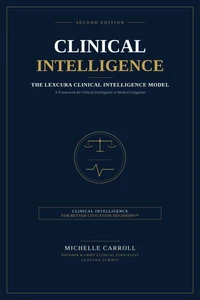
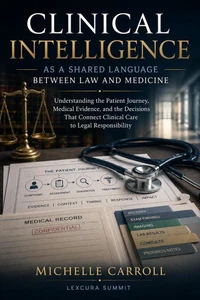
The Doctrine of Clinical IntelligenceTHow Better Clinical Understanding Leads to Better Litigation DecisionsHealthcare litigation is built upon evidence. Yet despite increasingly detailed medical records, sophisticated diagnostics, expert opinions, and extensive documentation, professionals reviewing the same case frequently arrive at very different conclusions. Why?In The Doctrine of Clinical IntelligenceT, Michelle Carroll introduces Clinical IntelligenceT, a new discipline developed to bridge the gap between information and understanding.
Drawing on more than forty years of experience in healthcare, Carroll demonstrates that collecting evidence alone is not enough. Reliable professional judgment requires a disciplined process that transforms fragmented clinical information into a coherent understanding of the patient's complete journey. Rather than treating medical records as the story itself, Clinical IntelligenceT begins where every healthcare investigation should begin-with the patient.
From that foundation, readers are guided through a structured methodology that examines the integrity of the evidence, reconstructs the patient's baseline health and clinical timeline, evaluates professional decision-making within its proper context, considers regulatory and organizational influences, and ultimately assesses causation through a systematic framework designed to support objective analysis.
At the heart of the book is the Lexcura Clinical Intelligence MethodologyT, a comprehensive framework built upon seven interconnected pillars:. Record IntegrityT. Baseline ProfilingT. Timeline ReconstructionT. Standard of Care ReviewT. Regulatory & Compliance OverlayT. Causation MappingT. Litigation-Ready OutputTTogether, these pillars provide a disciplined approach for understanding complex healthcare events while avoiding many of the cognitive and evidentiary pitfalls that can influence clinical and legal decision-making.
More than a methodology, this book explores the philosophy behind professional understanding itself. It examines the distinction between information and knowledge, knowledge and understanding, experience and expertise, documentation and reality, and demonstrates why meaningful conclusions emerge only when evidence is examined within its complete clinical context. Written in a clear, accessible style, The Doctrine of Clinical IntelligenceT is intended for attorneys, healthcare professionals, clinical consultants, expert witnesses, investigators, insurers, risk managers, healthcare leaders, students, and anyone responsible for evaluating complex healthcare evidence.
Rather than advocating for plaintiffs or defendants, the methodology remains evidence-centered and patient-focused, providing a structured process for reaching more reliable and defensible conclusions. The book also establishes the philosophical and methodological foundation for the broader Clinical IntelligenceT body of work developed by Lexcura Summit, including professional education, certification, licensing, litigation support systems, and advanced clinical review methodologies.
Whether the goal is understanding adverse healthcare events, strengthening litigation strategy, improving case evaluation, supporting expert review, or developing more consistent approaches to healthcare investigations, The Doctrine of Clinical IntelligenceT offers a practical and intellectually rigorous framework for transforming evidence into understanding. Clinical IntelligenceT does not replace clinical expertise, legal judgment, or professional experience.
It strengthens them by providing a disciplined process for seeing the complete picture before consequential decisions are made. Because better understanding leads to better litigation decisions.
The Doctrine of Clinical IntelligenceTHow Better Clinical Understanding Leads to Better Litigation DecisionsHealthcare litigation is built upon evidence. Yet despite increasingly detailed medical records, sophisticated diagnostics, expert opinions, and extensive documentation, professionals reviewing the same case frequently arrive at very different conclusions. Why?In The Doctrine of Clinical IntelligenceT, Michelle Carroll introduces Clinical IntelligenceT, a new discipline developed to bridge the gap between information and understanding.
Drawing on more than forty years of experience in healthcare, Carroll demonstrates that collecting evidence alone is not enough. Reliable professional judgment requires a disciplined process that transforms fragmented clinical information into a coherent understanding of the patient's complete journey. Rather than treating medical records as the story itself, Clinical IntelligenceT begins where every healthcare investigation should begin-with the patient.
From that foundation, readers are guided through a structured methodology that examines the integrity of the evidence, reconstructs the patient's baseline health and clinical timeline, evaluates professional decision-making within its proper context, considers regulatory and organizational influences, and ultimately assesses causation through a systematic framework designed to support objective analysis.
At the heart of the book is the Lexcura Clinical Intelligence MethodologyT, a comprehensive framework built upon seven interconnected pillars:. Record IntegrityT. Baseline ProfilingT. Timeline ReconstructionT. Standard of Care ReviewT. Regulatory & Compliance OverlayT. Causation MappingT. Litigation-Ready OutputTTogether, these pillars provide a disciplined approach for understanding complex healthcare events while avoiding many of the cognitive and evidentiary pitfalls that can influence clinical and legal decision-making.
More than a methodology, this book explores the philosophy behind professional understanding itself. It examines the distinction between information and knowledge, knowledge and understanding, experience and expertise, documentation and reality, and demonstrates why meaningful conclusions emerge only when evidence is examined within its complete clinical context. Written in a clear, accessible style, The Doctrine of Clinical IntelligenceT is intended for attorneys, healthcare professionals, clinical consultants, expert witnesses, investigators, insurers, risk managers, healthcare leaders, students, and anyone responsible for evaluating complex healthcare evidence.
Rather than advocating for plaintiffs or defendants, the methodology remains evidence-centered and patient-focused, providing a structured process for reaching more reliable and defensible conclusions. The book also establishes the philosophical and methodological foundation for the broader Clinical IntelligenceT body of work developed by Lexcura Summit, including professional education, certification, licensing, litigation support systems, and advanced clinical review methodologies.
Whether the goal is understanding adverse healthcare events, strengthening litigation strategy, improving case evaluation, supporting expert review, or developing more consistent approaches to healthcare investigations, The Doctrine of Clinical IntelligenceT offers a practical and intellectually rigorous framework for transforming evidence into understanding. Clinical IntelligenceT does not replace clinical expertise, legal judgment, or professional experience.
It strengthens them by providing a disciplined process for seeing the complete picture before consequential decisions are made. Because better understanding leads to better litigation decisions.

 , qui est-ce ?