Nouveauté
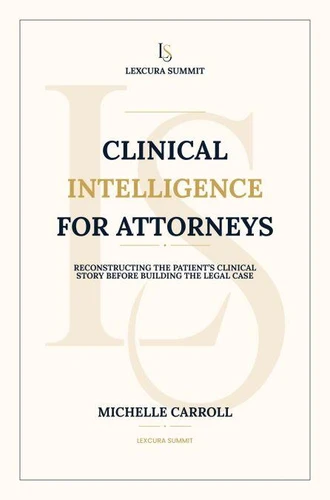
Clinical Intelligence for Attorneys
Par :Formats :
Disponible dans votre compte client Decitre ou Furet du Nord dès validation de votre commande. Le format ePub est :
- Compatible avec une lecture sur My Vivlio (smartphone, tablette, ordinateur)
- Compatible avec une lecture sur liseuses Vivlio
- Pour les liseuses autres que Vivlio, vous devez utiliser le logiciel Adobe Digital Edition. Non compatible avec la lecture sur les liseuses Kindle, Remarkable et Sony
 , qui est-ce ?
Notre partenaire de plateforme de lecture numérique où vous retrouverez l'ensemble de vos ebooks gratuitement
Pour en savoir plus sur nos ebooks, consultez notre aide en ligne ici
C'est si simple ! Lisez votre ebook avec l'app Vivlio sur votre tablette, mobile ou ordinateur :

- FormatePub
- ISBN8997229740
- EAN9798997229740
- Date de parution22/07/2026
- Protection num.pas de protection
- Infos supplémentairesepub
- ÉditeurMichelle Carroll
Résumé
Clinical Intelligence for Attorneys introduces a more disciplined way to interpret medical records, evaluate clinical evidence, and make better-informed litigation decisions. Attorneys routinely receive thousands of pages of medical records, yet the volume of documentation does not guarantee clarity. Important clinical relationships may be buried across multiple facilities, providers, specialties, and episodes of care.
A chronology may show what was documented, but it does not necessarily explain what the evidence means, what should have occurred, or whether an alleged failure materially affected the outcome. This book bridges that gap. Michelle Carroll presents Clinical Intelligence as a structured method for examining medical evidence through the combined analysis of record integrity, patient baseline, timeline reconstruction, standard of care, regulatory responsibility, and causation.
Written for attorneys handling medical malpractice, personal injury, wrongful death, long-term care, healthcare liability, and other medically complex matters, this book explains how to move beyond surface-level record review and identify the clinical issues that may strengthen, weaken, or fundamentally change a case. Readers will learn how to:Understand the difference between medical documentation and clinical reality.
Recognize missing, inconsistent, duplicated, or unreliable records. Establish the patient's true clinical baseline before evaluating injury or deterioration. Identify critical decision points and missed opportunities within the timeline. Distinguish an adverse outcome from a potential breach in the standard of care. Evaluate whether regulatory and organizational failures contributed to the event. Separate clinical correlation from legally meaningful causation.
Ask more precise questions of clinicians, experts, witnesses, and opposing counsel. Determine when the evidence supports further investment, early resolution, or strategic withdrawal. Clinical Intelligence does not replace legal judgment, expert testimony, or clinical expertise. It strengthens the attorney's ability to use each of them more effectively. By learning to see the medical record as an interconnected clinical system rather than a collection of documents, attorneys can evaluate cases earlier, prepare more effectively, reduce avoidable assumptions, and make litigation decisions with greater clarity and confidence.
A chronology may show what was documented, but it does not necessarily explain what the evidence means, what should have occurred, or whether an alleged failure materially affected the outcome. This book bridges that gap. Michelle Carroll presents Clinical Intelligence as a structured method for examining medical evidence through the combined analysis of record integrity, patient baseline, timeline reconstruction, standard of care, regulatory responsibility, and causation.
Written for attorneys handling medical malpractice, personal injury, wrongful death, long-term care, healthcare liability, and other medically complex matters, this book explains how to move beyond surface-level record review and identify the clinical issues that may strengthen, weaken, or fundamentally change a case. Readers will learn how to:Understand the difference between medical documentation and clinical reality.
Recognize missing, inconsistent, duplicated, or unreliable records. Establish the patient's true clinical baseline before evaluating injury or deterioration. Identify critical decision points and missed opportunities within the timeline. Distinguish an adverse outcome from a potential breach in the standard of care. Evaluate whether regulatory and organizational failures contributed to the event. Separate clinical correlation from legally meaningful causation.
Ask more precise questions of clinicians, experts, witnesses, and opposing counsel. Determine when the evidence supports further investment, early resolution, or strategic withdrawal. Clinical Intelligence does not replace legal judgment, expert testimony, or clinical expertise. It strengthens the attorney's ability to use each of them more effectively. By learning to see the medical record as an interconnected clinical system rather than a collection of documents, attorneys can evaluate cases earlier, prepare more effectively, reduce avoidable assumptions, and make litigation decisions with greater clarity and confidence.
A propos de Michelle Carroll


11,49 €
26,49 €
30,49 €
30,49 €
26,49 €
11,49 €
26,99 €