Gideon Hart is a nonfiction author who writes about leadership, philosophy, and the psychology of decision-making. His work explores how discipline, resilience, and long-term thinking shape both personal growth and success in times of uncertainty.
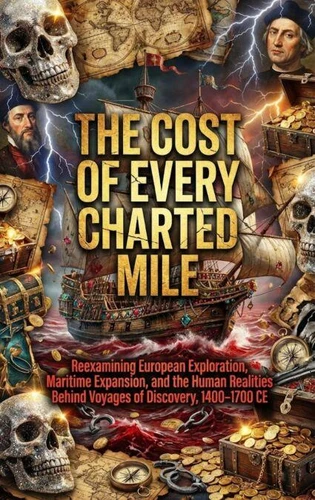
The Cost of Every Charted Mile. Reexamining European Exploration, Maritime Expansion, and the Human Realities Behind Voyages of Discovery, 1400–1700 CE
Par :Formats :
Disponible dans votre compte client Decitre ou Furet du Nord dès validation de votre commande. Le format ePub est :
- Compatible avec une lecture sur My Vivlio (smartphone, tablette, ordinateur)
- Compatible avec une lecture sur liseuses Vivlio
- Pour les liseuses autres que Vivlio, vous devez utiliser le logiciel Adobe Digital Edition. Non compatible avec la lecture sur les liseuses Kindle, Remarkable et Sony
 , qui est-ce ?
Notre partenaire de plateforme de lecture numérique où vous retrouverez l'ensemble de vos ebooks gratuitement
Pour en savoir plus sur nos ebooks, consultez notre aide en ligne ici
C'est si simple ! Lisez votre ebook avec l'app Vivlio sur votre tablette, mobile ou ordinateur :

- Nombre de pages156
- FormatePub
- ISBN978-3-565-19878-8
- EAN9783565198788
- Date de parution27/01/2026
- Protection num.pas de protection
- Taille2 Mo
- Infos supplémentairesepub
- ÉditeurEmphaloz Publishing House
Résumé
The Age of Exploration reshaped the world-but not through the heroic narratives that dominate textbooks. Behind every charted coastline lay brutal working conditions aboard overcrowded ships, behind every landing stood Indigenous communities whose knowledge made survival possible, and behind every profitable voyage stretched supply chains built on enslaved labor and resource extraction.
This book traces European maritime expansion through multiple perspectives: the sailors who endured scurvy, shipwreck, and mutiny for wages that often never materialized; the navigators who relied heavily on African and Asian pilots while claiming sole credit; the coastal communities who watched foreign ships arrive with mounting alarm; and the merchants who calculated profit margins against human suffering.
It examines how technological innovations in shipbuilding and navigation enabled longer voyages, how competing European powers justified territorial claims through dubious legal frameworks, and how early contact moments revealed profound misunderstandings on all sides. Drawing on ship logs, survivor accounts, Indigenous oral histories preserved in colonial records, and archaeological evidence from shipwrecks and early settlements, it reveals the environmental devastation of resource extraction, the deliberate destruction of local maritime traditions, and the demographic catastrophe that followed European arrival in the Americas.
It explores how disease, violence, and forced labor systems accompanied every expedition, and how exploration narratives systematically erased these realities. This is an unflinching examination of how curiosity, ambition, and greed combined to create global connections through profoundly unequal exchanges.
It examines how technological innovations in shipbuilding and navigation enabled longer voyages, how competing European powers justified territorial claims through dubious legal frameworks, and how early contact moments revealed profound misunderstandings on all sides. Drawing on ship logs, survivor accounts, Indigenous oral histories preserved in colonial records, and archaeological evidence from shipwrecks and early settlements, it reveals the environmental devastation of resource extraction, the deliberate destruction of local maritime traditions, and the demographic catastrophe that followed European arrival in the Americas.
It explores how disease, violence, and forced labor systems accompanied every expedition, and how exploration narratives systematically erased these realities. This is an unflinching examination of how curiosity, ambition, and greed combined to create global connections through profoundly unequal exchanges.