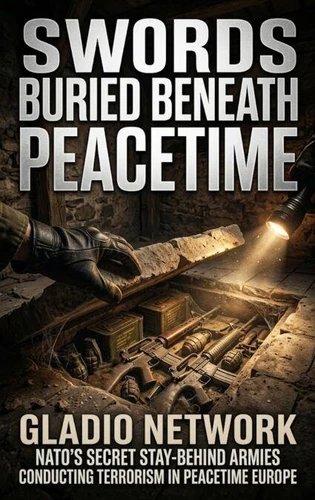
Swords Buried Beneath Peacetime. Gladio Network NATO's Secret Stay-Behind Armies Conducting Terrorism in Peacetime Europe
Par :Formats :
Disponible dans votre compte client Decitre ou Furet du Nord dès validation de votre commande. Le format ePub est :
- Compatible avec une lecture sur My Vivlio (smartphone, tablette, ordinateur)
- Compatible avec une lecture sur liseuses Vivlio
- Pour les liseuses autres que Vivlio, vous devez utiliser le logiciel Adobe Digital Edition. Non compatible avec la lecture sur les liseuses Kindle, Remarkable et Sony
 , qui est-ce ?
Notre partenaire de plateforme de lecture numérique où vous retrouverez l'ensemble de vos ebooks gratuitement
Pour en savoir plus sur nos ebooks, consultez notre aide en ligne ici
C'est si simple ! Lisez votre ebook avec l'app Vivlio sur votre tablette, mobile ou ordinateur :

- Nombre de pages177
- FormatePub
- ISBN978-3-565-45197-5
- EAN9783565451975
- Date de parution21/05/2026
- Protection num.pas de protection
- Taille1 Mo
- Infos supplémentairesepub
- ÉditeurEmphaloz Publishing House
Résumé
This book examines how a defensive military architecture, designed for wartime occupation resistance, became structurally repurposed for domestic political manipulation in peacetime, not through a single decision, but through the systemic logic of covert infrastructure operating without democratic oversight across sixteen European nations for nearly four decades.
Three interlocking mechanisms define Gladio's institutional trajectory.
First, the dual command structure, the Clandestine Planning Committee and the Allied Clandestine Committee, both linked to NATO's SHAPE, created deliberate information silos between civilian governments and their own military intelligence services, ensuring elected officials remained functionally excluded from operational knowledge. Second, the original anti-communist vetting logic that populated these networks with far-right civilian operatives produced an embedded ideological bias within the infrastructure itself.
The networks' relationship with organizations like Italy's P2 lodge and its documented connections to the Piazza Fontana bombing and the Brabant massacres reveal how covert assets pursued institutional survival by converting original mission parameters into active domestic leverage. Third, the weapons caches, including 139 confirmed sites in Italy alone, represented a material commitment that outlasted the strategic rationale that created them, transforming defensive resources into latent instruments of internal destabilization.
First, the dual command structure, the Clandestine Planning Committee and the Allied Clandestine Committee, both linked to NATO's SHAPE, created deliberate information silos between civilian governments and their own military intelligence services, ensuring elected officials remained functionally excluded from operational knowledge. Second, the original anti-communist vetting logic that populated these networks with far-right civilian operatives produced an embedded ideological bias within the infrastructure itself.
The networks' relationship with organizations like Italy's P2 lodge and its documented connections to the Piazza Fontana bombing and the Brabant massacres reveal how covert assets pursued institutional survival by converting original mission parameters into active domestic leverage. Third, the weapons caches, including 139 confirmed sites in Italy alone, represented a material commitment that outlasted the strategic rationale that created them, transforming defensive resources into latent instruments of internal destabilization.