- Accueil /
- SILAS HALE
SILAS HALE

Dernière sortie
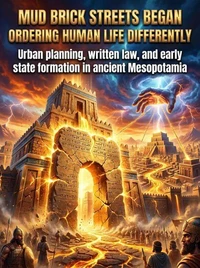
Mud Brick Streets Began Ordering Human Life Differently
Civilization emerged first not through monuments alone, but through administration, measurement, and the organization of crowded urban life. In Mesopotamia, cities transformed scattered agricultural communities into societies governed by written law, taxation, and centralized authority.
This book examines how ancient Babylon and earlier Mesopotamian cultures developed foundational systems of urban civilization.
Planned streets, defensive walls, temples, and administrative centers reshaped social organization between the Tigris and Euphrates rivers. Economic coordination required record keeping, legal codification, and mathematical precision on a scale unprecedented in earlier human history. The narrative also explores the significance of the Code of Hammurabi and the development of sexagesimal mathematics.
Written law established formal hierarchies and commercial regulation, while numerical systems designed for astronomy, trade, and land measurement influenced scientific thought for centuries afterward. Governance increasingly depended on literacy and bureaucratic continuity rather than personal memory alone. Mesopotamia appears here not simply as the birthplace of cities, but as the origin of systems that continue to structure law, administration, and urban society in the modern world.
Planned streets, defensive walls, temples, and administrative centers reshaped social organization between the Tigris and Euphrates rivers. Economic coordination required record keeping, legal codification, and mathematical precision on a scale unprecedented in earlier human history. The narrative also explores the significance of the Code of Hammurabi and the development of sexagesimal mathematics.
Written law established formal hierarchies and commercial regulation, while numerical systems designed for astronomy, trade, and land measurement influenced scientific thought for centuries afterward. Governance increasingly depended on literacy and bureaucratic continuity rather than personal memory alone. Mesopotamia appears here not simply as the birthplace of cities, but as the origin of systems that continue to structure law, administration, and urban society in the modern world.
Civilization emerged first not through monuments alone, but through administration, measurement, and the organization of crowded urban life. In Mesopotamia, cities transformed scattered agricultural communities into societies governed by written law, taxation, and centralized authority.
This book examines how ancient Babylon and earlier Mesopotamian cultures developed foundational systems of urban civilization.
Planned streets, defensive walls, temples, and administrative centers reshaped social organization between the Tigris and Euphrates rivers. Economic coordination required record keeping, legal codification, and mathematical precision on a scale unprecedented in earlier human history. The narrative also explores the significance of the Code of Hammurabi and the development of sexagesimal mathematics.
Written law established formal hierarchies and commercial regulation, while numerical systems designed for astronomy, trade, and land measurement influenced scientific thought for centuries afterward. Governance increasingly depended on literacy and bureaucratic continuity rather than personal memory alone. Mesopotamia appears here not simply as the birthplace of cities, but as the origin of systems that continue to structure law, administration, and urban society in the modern world.
Planned streets, defensive walls, temples, and administrative centers reshaped social organization between the Tigris and Euphrates rivers. Economic coordination required record keeping, legal codification, and mathematical precision on a scale unprecedented in earlier human history. The narrative also explores the significance of the Code of Hammurabi and the development of sexagesimal mathematics.
Written law established formal hierarchies and commercial regulation, while numerical systems designed for astronomy, trade, and land measurement influenced scientific thought for centuries afterward. Governance increasingly depended on literacy and bureaucratic continuity rather than personal memory alone. Mesopotamia appears here not simply as the birthplace of cities, but as the origin of systems that continue to structure law, administration, and urban society in the modern world.
Les livres de SILAS HALE
Nouveauté

Nouveauté


8,49 €