Writes about productivity, self-discipline, and modern work culture with a measured, evidence-based tone.
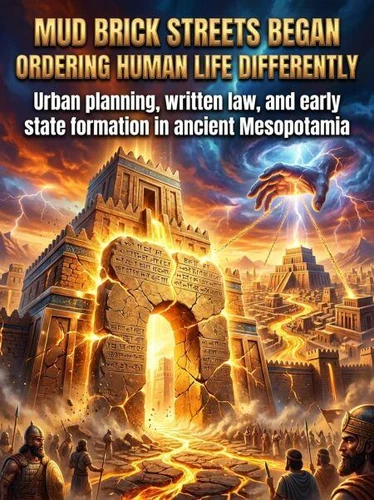
Mud Brick Streets Began Ordering Human Life Differently. Urban planning, written law, and early state formation in ancient Mesopotamia
Par :Formats :
Disponible dans votre compte client Decitre ou Furet du Nord dès validation de votre commande. Le format ePub est :
- Compatible avec une lecture sur My Vivlio (smartphone, tablette, ordinateur)
- Compatible avec une lecture sur liseuses Vivlio
- Pour les liseuses autres que Vivlio, vous devez utiliser le logiciel Adobe Digital Edition. Non compatible avec la lecture sur les liseuses Kindle, Remarkable et Sony
 , qui est-ce ?
Notre partenaire de plateforme de lecture numérique où vous retrouverez l'ensemble de vos ebooks gratuitement
Pour en savoir plus sur nos ebooks, consultez notre aide en ligne ici
C'est si simple ! Lisez votre ebook avec l'app Vivlio sur votre tablette, mobile ou ordinateur :

- Nombre de pages166
- FormatePub
- ISBN978-3-565-47931-3
- EAN9783565479313
- Date de parution05/06/2026
- Protection num.pas de protection
- Taille1 Mo
- Infos supplémentairesepub
- ÉditeurEmphaloz Publishing House
Résumé
Civilization emerged first not through monuments alone, but through administration, measurement, and the organization of crowded urban life. In Mesopotamia, cities transformed scattered agricultural communities into societies governed by written law, taxation, and centralized authority.
This book examines how ancient Babylon and earlier Mesopotamian cultures developed foundational systems of urban civilization.
Planned streets, defensive walls, temples, and administrative centers reshaped social organization between the Tigris and Euphrates rivers. Economic coordination required record keeping, legal codification, and mathematical precision on a scale unprecedented in earlier human history. The narrative also explores the significance of the Code of Hammurabi and the development of sexagesimal mathematics.
Written law established formal hierarchies and commercial regulation, while numerical systems designed for astronomy, trade, and land measurement influenced scientific thought for centuries afterward. Governance increasingly depended on literacy and bureaucratic continuity rather than personal memory alone. Mesopotamia appears here not simply as the birthplace of cities, but as the origin of systems that continue to structure law, administration, and urban society in the modern world.
Planned streets, defensive walls, temples, and administrative centers reshaped social organization between the Tigris and Euphrates rivers. Economic coordination required record keeping, legal codification, and mathematical precision on a scale unprecedented in earlier human history. The narrative also explores the significance of the Code of Hammurabi and the development of sexagesimal mathematics.
Written law established formal hierarchies and commercial regulation, while numerical systems designed for astronomy, trade, and land measurement influenced scientific thought for centuries afterward. Governance increasingly depended on literacy and bureaucratic continuity rather than personal memory alone. Mesopotamia appears here not simply as the birthplace of cities, but as the origin of systems that continue to structure law, administration, and urban society in the modern world.