Writes about productivity, self-discipline, and modern work culture with a measured, evidence-based tone.
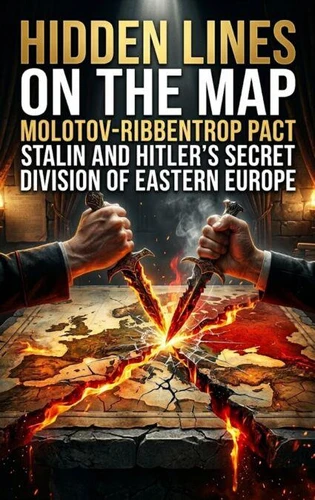
Hidden Lines on the Map. Molotov-Ribbentrop Pact Stalin and Hitler's Secret Division of Eastern Europe
Par :Formats :
Disponible dans votre compte client Decitre ou Furet du Nord dès validation de votre commande. Le format ePub est :
- Compatible avec une lecture sur My Vivlio (smartphone, tablette, ordinateur)
- Compatible avec une lecture sur liseuses Vivlio
- Pour les liseuses autres que Vivlio, vous devez utiliser le logiciel Adobe Digital Edition. Non compatible avec la lecture sur les liseuses Kindle, Remarkable et Sony
 , qui est-ce ?
Notre partenaire de plateforme de lecture numérique où vous retrouverez l'ensemble de vos ebooks gratuitement
Pour en savoir plus sur nos ebooks, consultez notre aide en ligne ici
C'est si simple ! Lisez votre ebook avec l'app Vivlio sur votre tablette, mobile ou ordinateur :

- Nombre de pages158
- FormatePub
- ISBN978-3-565-44885-2
- EAN9783565448852
- Date de parution18/05/2026
- Protection num.pas de protection
- Taille2 Mo
- Infos supplémentairesepub
- ÉditeurEmphaloz Publishing House
Résumé
The first mechanism examined is the controlled dissemination of secret information within the German Foreign Office and the Soviet People's Commissariat for Foreign Affairs. The protocol's existence was known only to a tiny inner circle, creating a tightly compartmentalized flow that prevented leaks but also limited broader institutional buy-in. This concentration of knowledge meant that diplomatic staff operating outside the inner circle continued to negotiate public agreements unaware of the underlying territorial carve-up, creating a mismatch between formal negotiations and actual strategic intentions.
The second mechanism concerns decision-making hierarchies at the highest level, where Joseph Stalin and Adolf Hitler treated the secret protocol as a binding commitment that allowed each to pursue immediate goals, Hitler's invasion of Poland and Soviet security buffers, while publicly maintaining a façade of non-aggression.
The hierarchical approval process ensured that once the leaders signed, lower-level officials had to implement the territorial shifts, even when it conflicted with prior understandings or public statements. The third mechanism involves incentive structures shaped by the promised territorial gains. Germany received a free hand in western Poland and secured its eastern flank, while the USSR obtained spheres of influence over the Baltic states, Bessarabia, and eastern Poland, which it later used to justify invasions and annexations.
These allocations altered the cost-benefit calculations for both regimes, making the secret protocol a high-reward, low-risk instrument in their strategic toolkit, at least until ideological conflict rendered it obsolete.
The hierarchical approval process ensured that once the leaders signed, lower-level officials had to implement the territorial shifts, even when it conflicted with prior understandings or public statements. The third mechanism involves incentive structures shaped by the promised territorial gains. Germany received a free hand in western Poland and secured its eastern flank, while the USSR obtained spheres of influence over the Baltic states, Bessarabia, and eastern Poland, which it later used to justify invasions and annexations.
These allocations altered the cost-benefit calculations for both regimes, making the secret protocol a high-reward, low-risk instrument in their strategic toolkit, at least until ideological conflict rendered it obsolete.