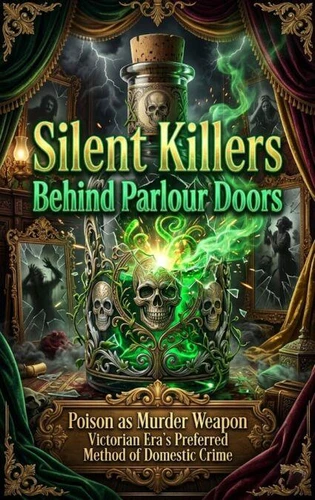
Silent Killers Behind Parlour Doors. Poison as Murder Weapon Victorian Era's Preferred Method of Domestic Crime
Par :Formats :
Disponible dans votre compte client Decitre ou Furet du Nord dès validation de votre commande. Le format ePub est :
- Compatible avec une lecture sur My Vivlio (smartphone, tablette, ordinateur)
- Compatible avec une lecture sur liseuses Vivlio
- Pour les liseuses autres que Vivlio, vous devez utiliser le logiciel Adobe Digital Edition. Non compatible avec la lecture sur les liseuses Kindle, Remarkable et Sony
 , qui est-ce ?
Notre partenaire de plateforme de lecture numérique où vous retrouverez l'ensemble de vos ebooks gratuitement
Pour en savoir plus sur nos ebooks, consultez notre aide en ligne ici
C'est si simple ! Lisez votre ebook avec l'app Vivlio sur votre tablette, mobile ou ordinateur :

- Nombre de pages185
- FormatePub
- ISBN978-3-565-45540-9
- EAN9783565455409
- Date de parution23/05/2026
- Protection num.pas de protection
- Taille2 Mo
- Infos supplémentairesepub
- ÉditeurEmphaloz Publishing House
Résumé
This book investigates how the quiet lethality of poison turned ordinary Victorian homes into stages of hidden violence, tracing the tension between the era's ideal of domestic sanctity and the reality that lethal substances could be administered across a tea-table or medicine bottle. The widespread availability of arsenic, cyanide, and strychnine-sold openly in grocers, chemists, and even as cosmetic aids-created a climate where acquiring a deadly agent required no special skill, yet detecting its use remained difficult for physicians and coroners.
This accessibility fostered a paradox: poison was both a household staple for medicine and pest control and, when misused, a weapon that left few outward traces, allowing murderers to exploit the very trust that defined middle-class life. The book analyses three interconnected mechanisms that transformed poison from a rare tool into a preferred method of domestic crime. First, the legal and regulatory lag-Parliament's 1851 Arsenic Act focused on hindering murderers while ignoring accidental poisonings-revealed how legislative attempts to curb crime often missed the everyday realities of poison circulation, leaving loopholes that perpetrators could exploit.
Second, the sensational press coverage of trials such as that of Madeleine Smith turned poisonings into public spectacles, simultaneously fueling a "poison panic" and providing a template for future offenders who saw notoriety as a possible outcome. Third, gender norms framed poisoning as a distinctly feminine crime, with courtroom discourse emphasizing women's supposed secrecy and connivance; this stereotype both shaped prosecutorial strategies and offered some women a perceived means of resistance against abusive marriages, even as it reinforced restrictive social expectations.
This accessibility fostered a paradox: poison was both a household staple for medicine and pest control and, when misused, a weapon that left few outward traces, allowing murderers to exploit the very trust that defined middle-class life. The book analyses three interconnected mechanisms that transformed poison from a rare tool into a preferred method of domestic crime. First, the legal and regulatory lag-Parliament's 1851 Arsenic Act focused on hindering murderers while ignoring accidental poisonings-revealed how legislative attempts to curb crime often missed the everyday realities of poison circulation, leaving loopholes that perpetrators could exploit.
Second, the sensational press coverage of trials such as that of Madeleine Smith turned poisonings into public spectacles, simultaneously fueling a "poison panic" and providing a template for future offenders who saw notoriety as a possible outcome. Third, gender norms framed poisoning as a distinctly feminine crime, with courtroom discourse emphasizing women's supposed secrecy and connivance; this stereotype both shaped prosecutorial strategies and offered some women a perceived means of resistance against abusive marriages, even as it reinforced restrictive social expectations.