SOLDES
Jusqu'à -70% sur une sélection d'articles*
- Accueil /
- Amelia Voss
Amelia Voss

Dernière sortie
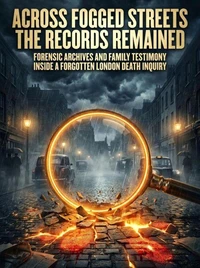
Across Fogged Streets the Records Remained
Decades after official conclusions hardened into accepted history, scattered documents began telling a different story. In archives darkened by time, fragments of testimony, medical notes, and private letters revealed how uncertainty had been buried beneath the confidence of institutional procedure.
This account follows the reconstruction of a mysterious death in London through the techniques of modern investigative journalism.
Drawing together sealed family papers, courtroom exchanges, and neglected forensic material, the book demonstrates how historical truth can survive inside incomplete records. Every contradiction between police accounts and witness testimony exposes the instability of the original investigation. At the same time, the narrative examines the broader structure of urban criminality in twentieth century London.
Financial elites, legal intermediaries, and senior officials moved through overlapping social circles where reputation carried political value. The justice system often struggled to distinguish impartial inquiry from the demands of class loyalty. As the family pursued answers across generations, the city itself appeared shaped by invisible negotiations between authority and influence. The result is both a historical investigation and a meditation on how archives preserve not certainty, but the traces of conflict left behind by power.
Drawing together sealed family papers, courtroom exchanges, and neglected forensic material, the book demonstrates how historical truth can survive inside incomplete records. Every contradiction between police accounts and witness testimony exposes the instability of the original investigation. At the same time, the narrative examines the broader structure of urban criminality in twentieth century London.
Financial elites, legal intermediaries, and senior officials moved through overlapping social circles where reputation carried political value. The justice system often struggled to distinguish impartial inquiry from the demands of class loyalty. As the family pursued answers across generations, the city itself appeared shaped by invisible negotiations between authority and influence. The result is both a historical investigation and a meditation on how archives preserve not certainty, but the traces of conflict left behind by power.
Decades after official conclusions hardened into accepted history, scattered documents began telling a different story. In archives darkened by time, fragments of testimony, medical notes, and private letters revealed how uncertainty had been buried beneath the confidence of institutional procedure.
This account follows the reconstruction of a mysterious death in London through the techniques of modern investigative journalism.
Drawing together sealed family papers, courtroom exchanges, and neglected forensic material, the book demonstrates how historical truth can survive inside incomplete records. Every contradiction between police accounts and witness testimony exposes the instability of the original investigation. At the same time, the narrative examines the broader structure of urban criminality in twentieth century London.
Financial elites, legal intermediaries, and senior officials moved through overlapping social circles where reputation carried political value. The justice system often struggled to distinguish impartial inquiry from the demands of class loyalty. As the family pursued answers across generations, the city itself appeared shaped by invisible negotiations between authority and influence. The result is both a historical investigation and a meditation on how archives preserve not certainty, but the traces of conflict left behind by power.
Drawing together sealed family papers, courtroom exchanges, and neglected forensic material, the book demonstrates how historical truth can survive inside incomplete records. Every contradiction between police accounts and witness testimony exposes the instability of the original investigation. At the same time, the narrative examines the broader structure of urban criminality in twentieth century London.
Financial elites, legal intermediaries, and senior officials moved through overlapping social circles where reputation carried political value. The justice system often struggled to distinguish impartial inquiry from the demands of class loyalty. As the family pursued answers across generations, the city itself appeared shaped by invisible negotiations between authority and influence. The result is both a historical investigation and a meditation on how archives preserve not certainty, but the traces of conflict left behind by power.
Les livres de Amelia Voss
Nouveauté

Nouveauté

Nouveauté

9,99 €


9,99 €