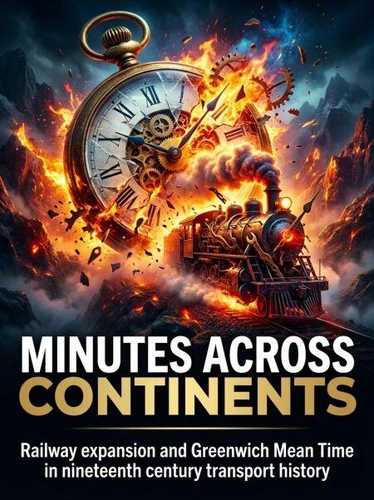
Minutes Across Continents. Railway expansion and Greenwich Mean Time in nineteenth century transport history
Par :Formats :
Disponible dans votre compte client Decitre ou Furet du Nord dès validation de votre commande. Le format ePub est :
- Compatible avec une lecture sur My Vivlio (smartphone, tablette, ordinateur)
- Compatible avec une lecture sur liseuses Vivlio
- Pour les liseuses autres que Vivlio, vous devez utiliser le logiciel Adobe Digital Edition. Non compatible avec la lecture sur les liseuses Kindle, Remarkable et Sony
 , qui est-ce ?
Notre partenaire de plateforme de lecture numérique où vous retrouverez l'ensemble de vos ebooks gratuitement
Pour en savoir plus sur nos ebooks, consultez notre aide en ligne ici
C'est si simple ! Lisez votre ebook avec l'app Vivlio sur votre tablette, mobile ou ordinateur :

- Nombre de pages155
- FormatePub
- ISBN978-3-565-46506-4
- EAN9783565465064
- Date de parution28/05/2026
- Protection num.pas de protection
- Taille1 Mo
- Infos supplémentairesepub
- ÉditeurEmphaloz Publishing House
Résumé
Railway history changed more than transportation. It reorganized how millions understood morning, distance, labor, and national authority. During the nineteenth century, every city still followed its own solar clock, creating confusion that spread with every expanding rail line across Europe and North America.
As railway networks accelerated industrial society, local time became a growing threat to coordination and safety.
Conductors, station masters, insurers, and telegraph operators faced impossible scheduling conflicts where neighboring towns differed by minutes that could decide collisions, missed cargo, or financial loss. Corporate railway archives reveal how private companies quietly became architects of a global temporal order long before governments accepted standardized clocks. Newspaper debates from London, New York, and Berlin exposed fears that communities were surrendering civic identity to industrial discipline.
At the same time, submarine telegraph cables and expanding empires pushed merchants and diplomats toward a single international reference point. The International Meridian Conference of 1884 formalized Greenwich Mean Time as the framework for a connected world, transforming railway necessity into geopolitical infrastructure. The adoption of standard time reshaped modern Europe beyond transportation alone.
Factories, stock exchanges, military planning, and colonial administration all inherited the railway clock, binding daily life to synchronized systems that still govern the modern world.
Conductors, station masters, insurers, and telegraph operators faced impossible scheduling conflicts where neighboring towns differed by minutes that could decide collisions, missed cargo, or financial loss. Corporate railway archives reveal how private companies quietly became architects of a global temporal order long before governments accepted standardized clocks. Newspaper debates from London, New York, and Berlin exposed fears that communities were surrendering civic identity to industrial discipline.
At the same time, submarine telegraph cables and expanding empires pushed merchants and diplomats toward a single international reference point. The International Meridian Conference of 1884 formalized Greenwich Mean Time as the framework for a connected world, transforming railway necessity into geopolitical infrastructure. The adoption of standard time reshaped modern Europe beyond transportation alone.
Factories, stock exchanges, military planning, and colonial administration all inherited the railway clock, binding daily life to synchronized systems that still govern the modern world.