Process safety has traditionally focused on preventing failure in refineries, chemical plants, pharmaceutical facilities, and hazardous storage terminals. Yet industrial accidents are rarely caused simply by equipment or procedural failures. They are often the consequence of unresolved contradictions between competing objectives: increasing production while maintaining strict safety margins, improving industrial cybersecurity while keeping operations uninterrupted, and pursuing operational efficiency while meeting demanding environmental and regulatory requirements under frameworks such as Seveso III, ATEX, and REACH.
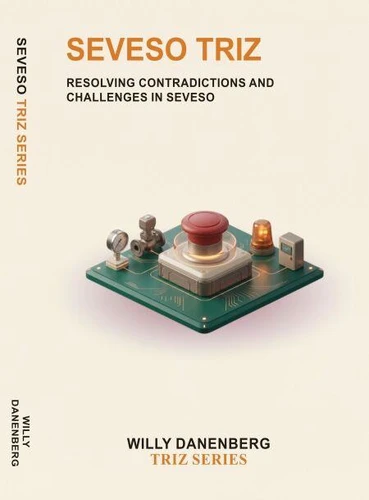
Seveso TRIZ asks a more valuable question than how to comply with regulations: how can organizations eliminate the contradictions that create risk in the first place? Applying the Theory of Inventive Problem Solving (TRIZ) to high-risk industrial environments, this original methodology gives engineers, process safety professionals, plant managers, and executives a structured way to identify the true conflict behind an operational challenge and redesign systems so that competing objectives reinforce one another instead of forcing compromise.
The book connects engineering design, operational excellence, industrial cybersecurity, environmental stewardship, maintenance, and emergency preparedness into a single decision-making framework, applied before incidents occur rather than only after investigations are completed. Through detailed contradiction analysis and practical playbooks grounded in process safety, hazardous materials management, and operational risk, it moves organizations beyond a compliance mindset toward a culture where innovation becomes part of safety itself.
Written by Willy Danenberg, an independent consultant and executive advisor specializing in IT governance, cybersecurity, digital transformation, risk management, and organizational leadership, this book is designed for process safety engineers, plant managers, environmental specialists, industrial cybersecurity professionals, emergency planners, and executives responsible for hazardous industrial operations.
It complements existing safety management systems and regulatory frameworks, offering a disciplined path toward resilience in industries where the margin for error is exceptionally small.
Process safety has traditionally focused on preventing failure in refineries, chemical plants, pharmaceutical facilities, and hazardous storage terminals. Yet industrial accidents are rarely caused simply by equipment or procedural failures. They are often the consequence of unresolved contradictions between competing objectives: increasing production while maintaining strict safety margins, improving industrial cybersecurity while keeping operations uninterrupted, and pursuing operational efficiency while meeting demanding environmental and regulatory requirements under frameworks such as Seveso III, ATEX, and REACH.
Seveso TRIZ asks a more valuable question than how to comply with regulations: how can organizations eliminate the contradictions that create risk in the first place? Applying the Theory of Inventive Problem Solving (TRIZ) to high-risk industrial environments, this original methodology gives engineers, process safety professionals, plant managers, and executives a structured way to identify the true conflict behind an operational challenge and redesign systems so that competing objectives reinforce one another instead of forcing compromise.
The book connects engineering design, operational excellence, industrial cybersecurity, environmental stewardship, maintenance, and emergency preparedness into a single decision-making framework, applied before incidents occur rather than only after investigations are completed. Through detailed contradiction analysis and practical playbooks grounded in process safety, hazardous materials management, and operational risk, it moves organizations beyond a compliance mindset toward a culture where innovation becomes part of safety itself.
Written by Willy Danenberg, an independent consultant and executive advisor specializing in IT governance, cybersecurity, digital transformation, risk management, and organizational leadership, this book is designed for process safety engineers, plant managers, environmental specialists, industrial cybersecurity professionals, emergency planners, and executives responsible for hazardous industrial operations.
It complements existing safety management systems and regulatory frameworks, offering a disciplined path toward resilience in industries where the margin for error is exceptionally small.