Every decision is shaped by how people perceive information, interpret evidence, and evaluate alternatives under uncertainty. Decades of research in cognitive psychology and behavioral economics have identified dozens of recurring biases, confirmation bias, anchoring, overconfidence, availability bias, loss aversion, and groupthink among them, yet poor decisions remain one of the leading causes of organizational failure.
Strategic initiatives collapse despite careful planning. Executive teams fall into groupthink. Organizations keep funding failing projects because of sunk costs. Artificial intelligence recommendations are either blindly accepted or dismissed outright. The problem is not a lack of information or analytical tools. It is a set of unresolved cognitive contradictions. Acting quickly may reduce analytical accuracy.
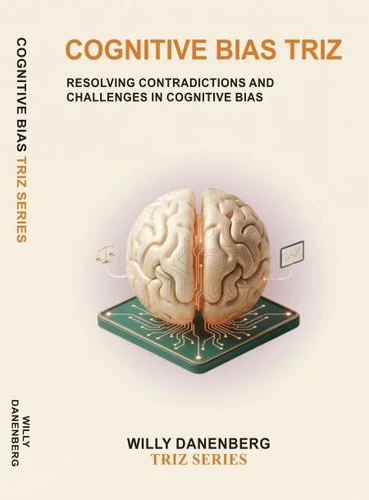
Gathering more information may delay timely action. Confidence can drive decisive leadership while fueling overconfidence. Consensus can strengthen alignment while suppressing useful disagreement. Cognitive Bias TRIZ presents an original methodology, inspired by the Theory of Inventive Problem Solving (TRIZ) and grounded in behavioral decision science, that reframes cognitive bias from an abstract psychological concept into a structured, actionable framework.
Instead of accepting trade-offs as inevitable, it asks a sharper question: can competing decision-making objectives be improved at the same time?Written by Willy Danenberg, an experienced IT governance, cybersecurity, and risk management consultant, this book equips executives, managers, project leaders, policymakers, and risk professionals with a systematic process for identifying and resolving the hidden contradictions that undermine judgment, strategy, and organizational performance, offering not just a catalog of biases, but a genuine method for making better decisions.
Every decision is shaped by how people perceive information, interpret evidence, and evaluate alternatives under uncertainty. Decades of research in cognitive psychology and behavioral economics have identified dozens of recurring biases, confirmation bias, anchoring, overconfidence, availability bias, loss aversion, and groupthink among them, yet poor decisions remain one of the leading causes of organizational failure.
Strategic initiatives collapse despite careful planning. Executive teams fall into groupthink. Organizations keep funding failing projects because of sunk costs. Artificial intelligence recommendations are either blindly accepted or dismissed outright. The problem is not a lack of information or analytical tools. It is a set of unresolved cognitive contradictions. Acting quickly may reduce analytical accuracy.
Gathering more information may delay timely action. Confidence can drive decisive leadership while fueling overconfidence. Consensus can strengthen alignment while suppressing useful disagreement. Cognitive Bias TRIZ presents an original methodology, inspired by the Theory of Inventive Problem Solving (TRIZ) and grounded in behavioral decision science, that reframes cognitive bias from an abstract psychological concept into a structured, actionable framework.
Instead of accepting trade-offs as inevitable, it asks a sharper question: can competing decision-making objectives be improved at the same time?Written by Willy Danenberg, an experienced IT governance, cybersecurity, and risk management consultant, this book equips executives, managers, project leaders, policymakers, and risk professionals with a systematic process for identifying and resolving the hidden contradictions that undermine judgment, strategy, and organizational performance, offering not just a catalog of biases, but a genuine method for making better decisions.