Modern organizations operate in environments defined by complexity, rapid change, and constant uncertainty. Every significant business decision forces leaders to balance competing priorities: encouraging innovation while maintaining operational discipline, empowering employees while preserving accountability, promoting collaboration while ensuring clear ownership, and accelerating decisions while managing risk.
Traditionally, these tensions have been treated as unavoidable trade-offs. Organizations assume that stronger governance reduces agility, that greater accountability limits innovation, or that more collaboration slows decision-making. These assumptions push leaders toward incremental optimization rather than rethinking how organizational systems actually function. Corporate Cognitive Organisational TRIZ offers a different path.
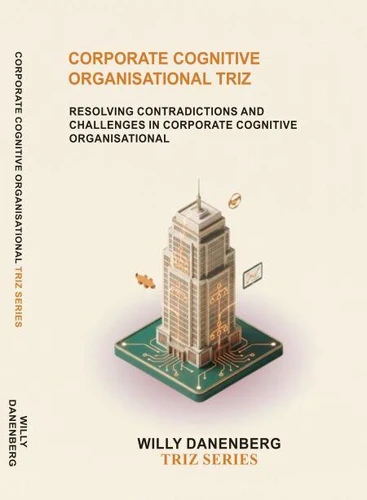
Adapting the Theory of Inventive Problem Solving (TRIZ), originally developed through the analysis of thousands of engineering innovations, this book applies contradiction-based thinking to organizational cognition, leadership, governance, and enterprise decision-making. Instead of accepting trade-offs as inevitable, it shows how competing objectives such as agility and control, autonomy and accountability, transparency and confidentiality, can often be improved together rather than balanced against each other.
Combining structured TRIZ methodology with insights from organizational psychology, cognitive science, behavioral economics, and systems thinking, author Willy Danenberg, an experienced IT governance, cybersecurity, and risk management consultant, equips executives, managers, governance professionals, and organizational leaders with a practical framework for diagnosing and systematically resolving the cognitive and structural contradictions that quietly limit performance.
Designed to complement, not replace, existing management and governance frameworks, this book provides a disciplined path toward stronger leadership, better decisions, and more resilient organizations, built not on compromise, but on genuine resolution.
Modern organizations operate in environments defined by complexity, rapid change, and constant uncertainty. Every significant business decision forces leaders to balance competing priorities: encouraging innovation while maintaining operational discipline, empowering employees while preserving accountability, promoting collaboration while ensuring clear ownership, and accelerating decisions while managing risk.
Traditionally, these tensions have been treated as unavoidable trade-offs. Organizations assume that stronger governance reduces agility, that greater accountability limits innovation, or that more collaboration slows decision-making. These assumptions push leaders toward incremental optimization rather than rethinking how organizational systems actually function. Corporate Cognitive Organisational TRIZ offers a different path.
Adapting the Theory of Inventive Problem Solving (TRIZ), originally developed through the analysis of thousands of engineering innovations, this book applies contradiction-based thinking to organizational cognition, leadership, governance, and enterprise decision-making. Instead of accepting trade-offs as inevitable, it shows how competing objectives such as agility and control, autonomy and accountability, transparency and confidentiality, can often be improved together rather than balanced against each other.
Combining structured TRIZ methodology with insights from organizational psychology, cognitive science, behavioral economics, and systems thinking, author Willy Danenberg, an experienced IT governance, cybersecurity, and risk management consultant, equips executives, managers, governance professionals, and organizational leaders with a practical framework for diagnosing and systematically resolving the cognitive and structural contradictions that quietly limit performance.
Designed to complement, not replace, existing management and governance frameworks, this book provides a disciplined path toward stronger leadership, better decisions, and more resilient organizations, built not on compromise, but on genuine resolution.