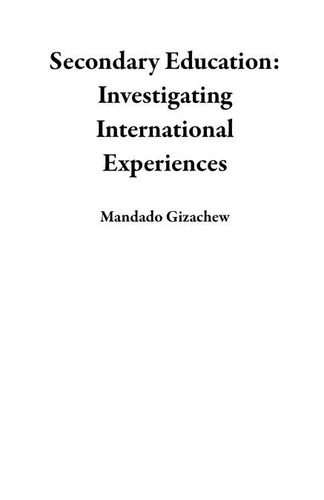
Secondary Education: Investigating International Experiences
Par :Formats :
Disponible dans votre compte client Decitre ou Furet du Nord dès validation de votre commande. Le format ePub est :
- Compatible avec une lecture sur My Vivlio (smartphone, tablette, ordinateur)
- Compatible avec une lecture sur liseuses Vivlio
- Pour les liseuses autres que Vivlio, vous devez utiliser le logiciel Adobe Digital Edition. Non compatible avec la lecture sur les liseuses Kindle, Remarkable et Sony
 , qui est-ce ?
Notre partenaire de plateforme de lecture numérique où vous retrouverez l'ensemble de vos ebooks gratuitement
Pour en savoir plus sur nos ebooks, consultez notre aide en ligne ici
C'est si simple ! Lisez votre ebook avec l'app Vivlio sur votre tablette, mobile ou ordinateur :

- FormatePub
- ISBN8233985188
- EAN9798233985188
- Date de parution27/02/2026
- Protection num.pas de protection
- Infos supplémentairesepub
- ÉditeurLinda Balsamo
Résumé
Secondary education has evolved globally as a pivotal stage bridging foundational literacy and advanced learning, shaped by historical legacies, philosophical debates, sociopolitical transformations, and global policy agendas. Recent scholarship emphasizes that contemporary secondary schooling must be understood as a product of layered historical developments intertwined with modernization, colonial encounters, democratization, and economic restructuring (Tikly, 2019; Verger, Fontdevila, & Zancajo, 2016).
Over the past decade, researchers have highlighted the dual function of secondary education: preparing youth for higher education and employment while also fostering civic identity, critical thinking, and social cohesion. Across regions, expansion of secondary education has been associated with human capital development and Sustainable Development Goal 4 (SDG4), which underscores equitable access and quality learning opportunities (UNESCO, 2023).
However, access, quality, and equity remain uneven, reflecting persistent structural inequalities rooted in historical and socioeconomic contexts. Historically, the architecture of secondary education in many regions reflects colonial and nation-building projects. In Asia and Africa, colonial administrations introduced Western-style secondary schools to produce administrative intermediaries, embedding stratified systems that privileged elites (Matasci, Jerónimo, & Dores, 2020).
In Europe, systems such as the French lycée and German gymnasium institutionalized standardized curricula and examination systems during 19th-century state formation (Zinkina et al., 2023). These models influenced global education through policy borrowing and diffusion. Contemporary analyses argue that colonial legacies continue to shape governance structures, language policies, and curricular hierarchies, often privileging academic tracks over vocational ones (Tikly, 2019).
Over the past decade, scholars have called for decolonizing secondary curricula to integrate indigenous knowledge and local histories, particularly in postcolonial contexts, aligning educational reform with cultural sovereignty and social justice (UNESCO, 2023). Philosophically, secondary education is grounded in competing normative visions concerning its aims and purposes. Drawing on contemporary interpretations of philosophical traditions discussed in the Stanford Encyclopedia of Philosophy (2020-2024 updates), scholars emphasize tensions between liberal humanist ideals, which prioritize intellectual autonomy and disciplinary knowledge, and pragmatist or progressive orientations that foreground experiential learning and democratic participation.
Recent philosophical scholarship (Biesta, 2020; Burbules, 2021) argues that secondary schooling should balance qualification (skills and knowledge), socialization (integration into societal norms), and subjectification (development of independent agency). These perspectives influence debates about curriculum breadth, civic education, and moral development. In the last decade, renewed attention has been given to ethical education, global citizenship, and sustainability, reflecting broader societal concerns about democratic resilience and environmental crisis.
Thus, philosophical foundations continue to inform contemporary curricular reforms and policy discussions.
Over the past decade, researchers have highlighted the dual function of secondary education: preparing youth for higher education and employment while also fostering civic identity, critical thinking, and social cohesion. Across regions, expansion of secondary education has been associated with human capital development and Sustainable Development Goal 4 (SDG4), which underscores equitable access and quality learning opportunities (UNESCO, 2023).
However, access, quality, and equity remain uneven, reflecting persistent structural inequalities rooted in historical and socioeconomic contexts. Historically, the architecture of secondary education in many regions reflects colonial and nation-building projects. In Asia and Africa, colonial administrations introduced Western-style secondary schools to produce administrative intermediaries, embedding stratified systems that privileged elites (Matasci, Jerónimo, & Dores, 2020).
In Europe, systems such as the French lycée and German gymnasium institutionalized standardized curricula and examination systems during 19th-century state formation (Zinkina et al., 2023). These models influenced global education through policy borrowing and diffusion. Contemporary analyses argue that colonial legacies continue to shape governance structures, language policies, and curricular hierarchies, often privileging academic tracks over vocational ones (Tikly, 2019).
Over the past decade, scholars have called for decolonizing secondary curricula to integrate indigenous knowledge and local histories, particularly in postcolonial contexts, aligning educational reform with cultural sovereignty and social justice (UNESCO, 2023). Philosophically, secondary education is grounded in competing normative visions concerning its aims and purposes. Drawing on contemporary interpretations of philosophical traditions discussed in the Stanford Encyclopedia of Philosophy (2020-2024 updates), scholars emphasize tensions between liberal humanist ideals, which prioritize intellectual autonomy and disciplinary knowledge, and pragmatist or progressive orientations that foreground experiential learning and democratic participation.
Recent philosophical scholarship (Biesta, 2020; Burbules, 2021) argues that secondary schooling should balance qualification (skills and knowledge), socialization (integration into societal norms), and subjectification (development of independent agency). These perspectives influence debates about curriculum breadth, civic education, and moral development. In the last decade, renewed attention has been given to ethical education, global citizenship, and sustainability, reflecting broader societal concerns about democratic resilience and environmental crisis.
Thus, philosophical foundations continue to inform contemporary curricular reforms and policy discussions.