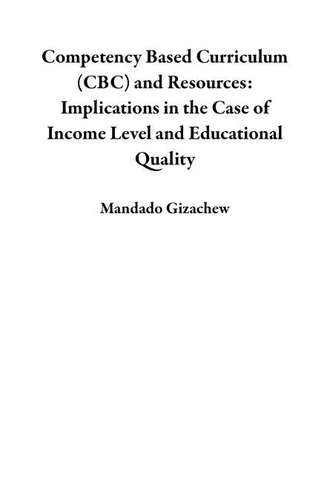
Competency Based Curriculum (CBC) and Resources: Implications in the Case of Income Level and Educational Quality
Par :Formats :
Disponible dans votre compte client Decitre ou Furet du Nord dès validation de votre commande. Le format ePub est :
- Compatible avec une lecture sur My Vivlio (smartphone, tablette, ordinateur)
- Compatible avec une lecture sur liseuses Vivlio
- Pour les liseuses autres que Vivlio, vous devez utiliser le logiciel Adobe Digital Edition. Non compatible avec la lecture sur les liseuses Kindle, Remarkable et Sony
 , qui est-ce ?
Notre partenaire de plateforme de lecture numérique où vous retrouverez l'ensemble de vos ebooks gratuitement
Pour en savoir plus sur nos ebooks, consultez notre aide en ligne ici
C'est si simple ! Lisez votre ebook avec l'app Vivlio sur votre tablette, mobile ou ordinateur :

- FormatePub
- ISBN8235377974
- EAN9798235377974
- Date de parution02/06/2026
- Protection num.pas de protection
- Infos supplémentairesepub
- ÉditeurIoakim Ioakim
Résumé
Competency-Based Curriculum (CBC) represents a learner-centered approach that emphasizes the acquisition and demonstration of competencies rather than the completion of prescribed content. Competencies are commonly defined as integrated combinations of knowledge, skills, attitudes, values, and dispositions that enable individuals to perform effectively in diverse contexts (Mulenga & Kabombwe, 2019).
CBC shifts attention from instructional inputs to learning outcomes, focusing on what learners can do with what they know. Educational success is measured through demonstrated mastery of competencies rather than time spent in instruction (OECD, 2024). This approach aligns with contemporary perspectives emphasizing lifelong learning, adaptability, innovation, and active citizenship (UNESCO, 2023). Competency-based curricula are distinguished by several key characteristics.
First, learning outcomes are explicitly defined and aligned with expected competencies (Mulenga & Kabombwe, 2019). Second, instructional practices emphasize learner-centered pedagogies such as inquiry-based learning, collaborative learning, problem-based learning, and project-based learning (Darling-Hammond et al., 2020). Third, assessment focuses on authentic demonstrations of learning and competency mastery rather than solely on knowledge recall (OECD, 2020).
Fourth, CBC promotes interdisciplinary learning and contextualized application of knowledge to real-life situations (UNESCO, 2021). Finally, the approach emphasizes the development of both cognitive and non-cognitive competencies, including communication, collaboration, creativity, digital literacy, and social responsibility (OECD, 2024). The successful implementation of CBC depends upon multiple interrelated determinants.
Policy commitment and effective educational leadership provide essential support for curriculum change processes (Fullan, 2020). Teacher competence is particularly critical because educators must possess the pedagogical knowledge and assessment skills necessary for learner-centered instruction (Darling-Hammond et al., 2020). Adequate resources, including teaching materials, technological infrastructure, and supportive learning environments, also significantly influence implementation outcomes (UNESCO, 2023).
Professional development programs enable teachers to understand competency frameworks and translate curriculum intentions into effective classroom practices (Orodho et al., 2024). Furthermore, alignment among curriculum objectives, pedagogical strategies, and assessment systems is necessary to ensure coherence and effectiveness (OECD, 2020).
CBC shifts attention from instructional inputs to learning outcomes, focusing on what learners can do with what they know. Educational success is measured through demonstrated mastery of competencies rather than time spent in instruction (OECD, 2024). This approach aligns with contemporary perspectives emphasizing lifelong learning, adaptability, innovation, and active citizenship (UNESCO, 2023). Competency-based curricula are distinguished by several key characteristics.
First, learning outcomes are explicitly defined and aligned with expected competencies (Mulenga & Kabombwe, 2019). Second, instructional practices emphasize learner-centered pedagogies such as inquiry-based learning, collaborative learning, problem-based learning, and project-based learning (Darling-Hammond et al., 2020). Third, assessment focuses on authentic demonstrations of learning and competency mastery rather than solely on knowledge recall (OECD, 2020).
Fourth, CBC promotes interdisciplinary learning and contextualized application of knowledge to real-life situations (UNESCO, 2021). Finally, the approach emphasizes the development of both cognitive and non-cognitive competencies, including communication, collaboration, creativity, digital literacy, and social responsibility (OECD, 2024). The successful implementation of CBC depends upon multiple interrelated determinants.
Policy commitment and effective educational leadership provide essential support for curriculum change processes (Fullan, 2020). Teacher competence is particularly critical because educators must possess the pedagogical knowledge and assessment skills necessary for learner-centered instruction (Darling-Hammond et al., 2020). Adequate resources, including teaching materials, technological infrastructure, and supportive learning environments, also significantly influence implementation outcomes (UNESCO, 2023).
Professional development programs enable teachers to understand competency frameworks and translate curriculum intentions into effective classroom practices (Orodho et al., 2024). Furthermore, alignment among curriculum objectives, pedagogical strategies, and assessment systems is necessary to ensure coherence and effectiveness (OECD, 2020).