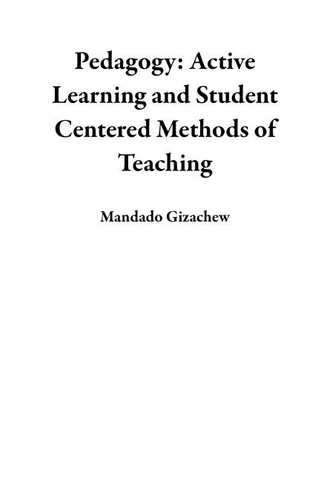
Pedagogy: Active Learning and Student Centered Methods of Teaching
Par :Formats :
Disponible dans votre compte client Decitre ou Furet du Nord dès validation de votre commande. Le format ePub est :
- Compatible avec une lecture sur My Vivlio (smartphone, tablette, ordinateur)
- Compatible avec une lecture sur liseuses Vivlio
- Pour les liseuses autres que Vivlio, vous devez utiliser le logiciel Adobe Digital Edition. Non compatible avec la lecture sur les liseuses Kindle, Remarkable et Sony
 , qui est-ce ?
Notre partenaire de plateforme de lecture numérique où vous retrouverez l'ensemble de vos ebooks gratuitement
Pour en savoir plus sur nos ebooks, consultez notre aide en ligne ici
C'est si simple ! Lisez votre ebook avec l'app Vivlio sur votre tablette, mobile ou ordinateur :

- FormatePub
- ISBN8232491918
- EAN9798232491918
- Date de parution20/01/2026
- Protection num.pas de protection
- Infos supplémentairesepub
- ÉditeurDraft2Digital
Résumé
Unit One establishes the conceptual foundations of pedagogy by examining its evolution across traditional (pre-modern), modern, and post-modern paradigms. Traditional pedagogy is characterized by teacher authority, knowledge transmission, and examination-oriented instruction, which continue to dominate many education systems due to cultural norms, resource constraints, and accountability pressures (OECD, 2018; UNESCO, 2020).
While such approaches can support classroom order and content coverage, contemporary research highlights their limitations in fostering critical thinking, creativity, and learner autonomy (Freeman et al., 2014; Biesta, 2019). Modern pedagogy, informed by scientific rationalism and constructivist learning theories, introduces structured yet interactive instructional designs that emphasize learning objectives, sequencing, and measurable outcomes, alongside active learning strategies such as problem-based and cooperative learning (Hattie, 2018).
Post-modern pedagogy further challenges universalized teaching models by emphasizing knowledge as socially constructed, culturally situated, and ethically mediated, foregrounding inclusivity, learner voice, and social justice (Giroux, 2020). Unit One concludes that contemporary pedagogy is best understood as a hybrid practice, requiring teachers to draw flexibly from multiple paradigms rather than adhering to a single pedagogical ideology.
While such approaches can support classroom order and content coverage, contemporary research highlights their limitations in fostering critical thinking, creativity, and learner autonomy (Freeman et al., 2014; Biesta, 2019). Modern pedagogy, informed by scientific rationalism and constructivist learning theories, introduces structured yet interactive instructional designs that emphasize learning objectives, sequencing, and measurable outcomes, alongside active learning strategies such as problem-based and cooperative learning (Hattie, 2018).
Post-modern pedagogy further challenges universalized teaching models by emphasizing knowledge as socially constructed, culturally situated, and ethically mediated, foregrounding inclusivity, learner voice, and social justice (Giroux, 2020). Unit One concludes that contemporary pedagogy is best understood as a hybrid practice, requiring teachers to draw flexibly from multiple paradigms rather than adhering to a single pedagogical ideology.