
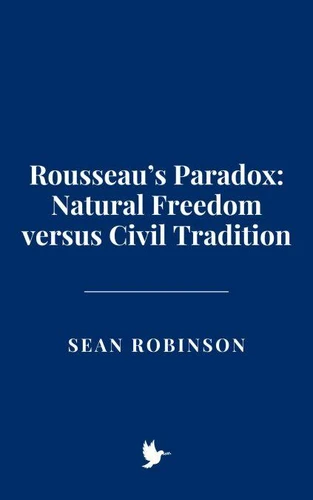
Rousseau’s Paradox: Natural Freedom versus Civil Tradition
Par :Formats :
Disponible dans votre compte client Decitre ou Furet du Nord dès validation de votre commande. Le format ePub est :
- Compatible avec une lecture sur My Vivlio (smartphone, tablette, ordinateur)
- Compatible avec une lecture sur liseuses Vivlio
- Pour les liseuses autres que Vivlio, vous devez utiliser le logiciel Adobe Digital Edition. Non compatible avec la lecture sur les liseuses Kindle, Remarkable et Sony
 , qui est-ce ?
Notre partenaire de plateforme de lecture numérique où vous retrouverez l'ensemble de vos ebooks gratuitement
Pour en savoir plus sur nos ebooks, consultez notre aide en ligne ici
C'est si simple ! Lisez votre ebook avec l'app Vivlio sur votre tablette, mobile ou ordinateur :

- FormatePub
- ISBN8231817092
- EAN9798231817092
- Date de parution19/06/2025
- Protection num.pas de protection
- Infos supplémentairesepub
- ÉditeurWalzone Press
Résumé
This book offers a definitive exploration of Jean-Jacques Rousseau's enduring paradox: how can humans be both naturally free and yet bound by the laws of society? Delving deep into Rousseau's groundbreaking works-the Discourse on Inequality and The Social Contract-it unpacks his radical critique of social and political inequality and his visionary redefinition of legitimate authority through the concept of the general will.
Blending rigorous historical analysis, philosophical interpretation, and rich contextual detail, the book reveals how Rousseau's ideas challenged the foundations of monarchy, aristocracy, and servitude, inspiring revolutions and reshaping modern democracy. From the origins of natural freedom to the birth of civil society, from the corrosive forces of faction and corruption to the promise of republican liberty grounded in active political participation, this volume illuminates Rousseau's complex dialectic of freedom and constraint.
It also traces the lasting influence of his thought on contemporary debates about citizenship, justice, and the nature of political power.
Blending rigorous historical analysis, philosophical interpretation, and rich contextual detail, the book reveals how Rousseau's ideas challenged the foundations of monarchy, aristocracy, and servitude, inspiring revolutions and reshaping modern democracy. From the origins of natural freedom to the birth of civil society, from the corrosive forces of faction and corruption to the promise of republican liberty grounded in active political participation, this volume illuminates Rousseau's complex dialectic of freedom and constraint.
It also traces the lasting influence of his thought on contemporary debates about citizenship, justice, and the nature of political power.
A propos de Sean Robinson
2,99 €
2,99 €
2,99 €
2,99 €
2,99 €
2,99 €