SOLDES
Jusqu'à -70% sur une sélection d'articles*

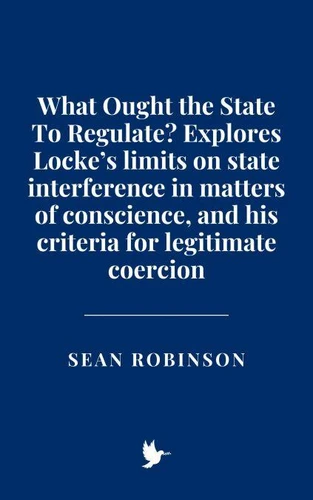
What Ought the State To Regulate? Explores Locke’s limits on state interference in matters of conscience, and his criteria for legitimate coercion
Par :Formats :
Disponible dans votre compte client Decitre ou Furet du Nord dès validation de votre commande. Le format ePub est :
- Compatible avec une lecture sur My Vivlio (smartphone, tablette, ordinateur)
- Compatible avec une lecture sur liseuses Vivlio
- Pour les liseuses autres que Vivlio, vous devez utiliser le logiciel Adobe Digital Edition. Non compatible avec la lecture sur les liseuses Kindle, Remarkable et Sony
 , qui est-ce ?
Notre partenaire de plateforme de lecture numérique où vous retrouverez l'ensemble de vos ebooks gratuitement
Pour en savoir plus sur nos ebooks, consultez notre aide en ligne ici
C'est si simple ! Lisez votre ebook avec l'app Vivlio sur votre tablette, mobile ou ordinateur :

- FormatePub
- ISBN8231880515
- EAN9798231880515
- Date de parution19/06/2025
- Protection num.pas de protection
- Infos supplémentairesepub
- ÉditeurWalzone Press
Résumé
In an age where the boundaries between personal conviction and public order are increasingly contested, What Ought the State To Regulate? offers a timely and profound examination of one of political philosophy's most enduring dilemmas: To what extent should the state regulate belief? Drawing deeply from John Locke's revolutionary insights on conscience, coercion, and toleration, this book traces the delicate balance between individual freedom and societal security that shapes modern democracy.
Unpacking Locke's seminal arguments with scholarly rigor and vivid historical context, What Ought the State To Regulate? reveals how his criteria for legitimate state intervention-grounded in reason, consent, and the protection of natural rights-continue to inform contemporary debates on religious freedom, hate speech, educational policy, and civic responsibility. From seventeenth-century England's religious turmoil to today's global pluralism and digital-age challenges, this volume explores the evolution, limits, and practical application of toleration within legal and political institutions.
Perfect for readers interested in philosophy, law, politics, and human rights, this work bridges historical scholarship and urgent contemporary questions. It challenges us to rethink the role of government in regulating belief, illuminating pathways toward societies that respect conscience without compromising order. A compelling and accessible guide to one of liberalism's greatest legacies, this book invites reflection on freedom, authority, and the enduring quest for just coexistence.
Unpacking Locke's seminal arguments with scholarly rigor and vivid historical context, What Ought the State To Regulate? reveals how his criteria for legitimate state intervention-grounded in reason, consent, and the protection of natural rights-continue to inform contemporary debates on religious freedom, hate speech, educational policy, and civic responsibility. From seventeenth-century England's religious turmoil to today's global pluralism and digital-age challenges, this volume explores the evolution, limits, and practical application of toleration within legal and political institutions.
Perfect for readers interested in philosophy, law, politics, and human rights, this work bridges historical scholarship and urgent contemporary questions. It challenges us to rethink the role of government in regulating belief, illuminating pathways toward societies that respect conscience without compromising order. A compelling and accessible guide to one of liberalism's greatest legacies, this book invites reflection on freedom, authority, and the enduring quest for just coexistence.
A propos de Sean Robinson
2,99 €
2,99 €
2,99 €

2,99 €
2,99 €
2,99 €